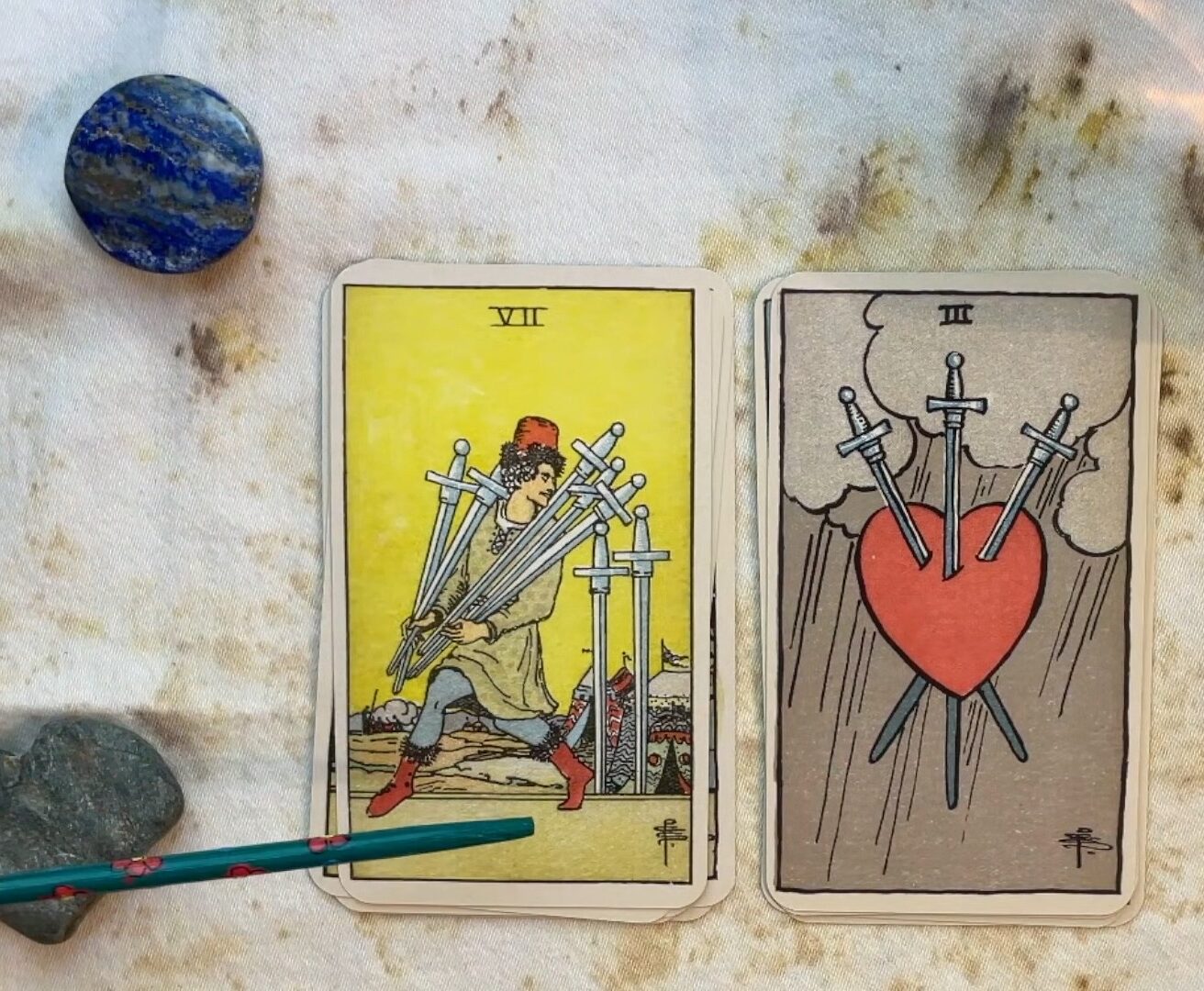
There are many associations for the suits in tarot, and I’ve recently noticed some parallels between common associations for the suits and The Eight Worldly Concerns or Eight Worldly Dharmas in Buddhism. While this isn’t groundbreaking (the categories should be fairly familiar, even if the wording is slightly different), drawing a direct line between these concepts and the classic suit associations from the Waite Smith imagery wasn’t something I had thought about directly before.
In Buddhist philosophy, we are taught that the cause of all our suffering can be viewed through hope and fear: hope of or attachment to getting what we want and holding on to it forever, and fear of or aversion to getting what we don’t want, and trying to ensure that bad things never happen to us. This dichotomy is further broken down into four mirrored categories.
Pleasure and Pain
This category includes both emotionally satisfying or painful feelings and physical pleasure and pain, since our attachment to the body has mostly to do with how our body makes us feel. For example, is our body in pain, is it uncomfortable, or are we experiencing something pleasurable like a good meal or a stimulating sexual encounter? We want to grasp on to these experiences for the “good” feelings they provide, and get rid of the experiences that engender “bad” ones.
For me this dovetails nicely with the feelings suit in the tarot, which many people would associate with cups or water. We can see this reflected in images like the romantic attraction depicted in the 2 of Cups, or in the 3 of Cups, celebrating with friends, enjoying a joyful moment together, perhaps imbibing alcohol and getting a bit buzzed. In contrast, we have cards like the 4 of Cups, which could reflect dullness or ennui, or the 5 of Cups, which depicts a solemn scene. In general, we do not want to feel sad, bored, emotionally overwhelmed, or disappointed.
Fame and Insignificance
In some tarot correspondences, the Wands (aka batons, staves) are related to not only passion and drive, but also the output of that passion and drive, which frames us in a public light. How we are seen by others, our reputation and the regard others have for us, is the framework for the second pair of Worldly Concerns, fame and insignificance. On the small scale, everyone wants to be seen for who they are, in the way they choose to present themselves. Everyone wants to be heard, taken seriously, and respected.
On a larger scale, we may be in pursuit of opportunities to be seen as powerful, glamorous, commanding, revered, and looked up to as a successful manifestation of human potential. In contrast, we don’t want to be seen as incompetent, stupid, boring, annoying, untrustworthy, or even worse, to become insignificant or forgotten altogether. This is why rich people leave funds to build statues of themselves after they die, or buy naming rights to museums and schools: they want fame and glory even after they are gone.
Praise and Blame
Here we look at words, both those spoken directly to us and about us. I’d associate this hope/fear pair with the swords suit and thoughts as they manifest as self-talk and speech from other people.
Praise in this context refers to hearing positive things about ourselves, which ties in with reputation, but is more focused on how people talk to us and about us. We want positive, gentle, or boosting words: “You’re so talented, you’re so smart, I am enraptured by your beauty, that was an excellent point, let’s go with your idea,” and so forth.
On the other hand, we don’t want to be scolded, admonished, ridiculed, shamed, or blamed for something that wasn’t our fault, or was beyond our control. We want to win the argument, make the other person look foolish by verbally pointing out their mistakes, or at the very least, defend ourselves aggressively in the comments section, so that people don’t say we are a “loser”.
Gain and Loss
Perhaps the most straightforward of the pairings when it comes to the tarot, gain and loss are reflected directly in many images of the RWS pentacles suit: we want to be youthful and spry, financially supported even beyond our basic needs, and we don’t want to be destitute, sickly, or lacking necessities. Beyond this, when we do have good fortune, we want to grasp onto it firmly; we don’t want circumstances to change, and the more we get the more we want to hold on, a common sight among the rich, who rarely give away significant portions of their wealth.
The same goes with personal health and comforts. We’re told that in order to have a healthier body, we need to change our diet and eat sustaining foods with less sugar and saturated fats, or that giving up factory-farmed meat and fast fashion will help us lower our impact on the shared environment. Instead, we cling to our habits out of wanting to maintain our sense of entitlement to luxury and indulgence. “Other people get to have these things, so why should I give them up? It’s not fair.”
In a Reading
I haven’t had a chance to experiment with this very much, though as I mentioned, these concepts are fairly familiar with tarot, just rephrased slightly here. However, I do think this framework could be especially useful in two situations.
First, in the case where we are using a formal spread structure with positive and negative positions, for example, positions representing obstacle, challenge, blessing, or support. It can be difficult to interpret a so-called “negative” card in a positive position, for example the 5 of Pentacles as a blessing, or a “positive” card like the 10 of Cups in an obstacle position. But instead of interpreting these cards as situations, we can interpret them as attitudes, or hopes and fears.
For example, “You are very attached to the idea of getting a promotion, but the rest of the cards are telling me that is unlikely to happen at this time. This appears to be limitation in your current job, but could serve as inspiration to look for another position with better salary and work/life balance.” The blessing here is the push for the person to seek something that brings greater personal reward or puts them in a better financial position.
The second scenario is related, but has more to do with reading the person’s inner dialogue with themselves than it does outer circumstances. For example, the 3 of Cups and 5 of Swords together could be read as “it looks like you’re worried that if you don’t go out partying with your group of friends all the time, they’re going to say that they don’t like spending time with you”.
I’m curious what you think of these ideas. If you try them in a reading please let me know what you learn. And if you use other correspondences that aren’t the typical ones we learn from tarot books, I’d love to learn about those too – please leave a link to your blog, VR, or social media post in the comments.