Thank you for your interest in this revamped tag!
The original #PacingTheTarot was put forward to help us slow down the purchase / purge cycle and spend some time deeply considering a few decks, rather than reassessing our entire collection. Instead of an anti-haul, this is a chance to deeply consider our choices and how those impact our use of divination.
Here is the structure for a response:
- Choose up to 3 decks in total that you have “problems” with, as responses to one or more of these categories. You can use tarot, oracle, playing cards, or any other type of divination pack.
- A deck you’ve never used, or tried using once and haven’t returned to. What happened there?
- An “oldie but a goodie” that you used regularly at one time, but has since fallen out of rotation. Why might that be?
- A deck that makes you reassess something – about yourself, your practice, your tastes, your goals. What uncomfortable questions is this item raising for you?
- For each response:
- Identify how you acquired the deck.
- Identify why you’ve not been using the deck or what you think is dampening your enthusiasm.
- Suggest some way you could address the problem, if you want to make a change.
The accompanying video has examples of each response, and you likely have others.
Why this tag, why now?
A few years ago, my friend Saoirse Graves (then publishing under a different channel name), put out a set of prompts for doing an in-depth assessment of decks that might not be working as well for us as they had been, or that we hoped they would. The intention of the tag, as Saoirse tells it, was to slow down the spontaneous acquisition of new tools so that we could more fully integrate what we have into our practices, and avoid the overwhelm of too-much-too-fast, or rehoming a deck and then finding we regretted that choice (both things I know many of us have experienced from time to time).
While the original hashtag (#PacingTheTarot) might have been a little opaque, I was all for the intention of it, and looking back after a few years, I felt the time was right for me to do a response. My collection has been fairly stable for the last 3 years, and I feel comfortable with it on the whole. But with 70 tarots and a few other types of card packs, there are certainly a few that don’t get used much. The question is, is it time to reintegrate them, move them along, or just let them hang out a bit longer?
How do you know what needs evaluating?
This tag was never meant to be a wholesale evaluation. With a maximum of 3 decks, it’s meant to be a thoughtful reflection on just a few items. But with a mid- or large-size collection (I’ll leave it to the reader to define those terms) how do we decide what to evaluate? Again, I think that’s going to depend on your goals for collecting and the overall composition of your collection. Here are some thoughts based on different ways we might view our decks.
As Tool for Introspection / Investigation
About half my collection falls into this category. I like to read tarot primarily, sometimes combined with oracle, on topics ranging from self discovery (why am I blocked about this thing right now?) to mundane (what can I make for dinner to shake up our culinary rut?) to inter-personal (what is going on with this colleague, and how can I have better interactions with them?).
To alleviate boredom and inspire me to read consistently, I like to access different art styles, color palettes, pip arrangements, characters, and themes. This gives me the flexibility to choose a deck based on the question, my mood, the season, the colors I’m enjoying in that moment, or the preferences of the person I’m reading for. My “reader decks” include a few historic-inspired decks that read well for me, such as I Naibi di Giovanni Vacchetta, Trionfi Della Luna, Spanish Tarot, and Dinosaures de Marseille; modern decks like the Gaian Tarot, Tarot de Carlotydes, and Fifth Spirit Tarot; as well as pop culture packs like Grateful Dead Tarot and Nightmare Before Christmas Tarot.
As Objects / Artifacts / Art
The other half of my collection falls into this category. There are a few collector’s items, such as the first-edition University Books Pamela Coleman Smith Tarot Cards from 1959, the Keishobu Tarot from Japan, Sabat Magazine’s Le Tarot de L’Etoile Cachée, and UTarot 2022, with art by Ralph Steadman of Fear and Loathing in Los Vegas fame (actually quite a good reader as well). These are generally for learning, appreciation, and comparing to contemporary and modern interpretations and imagery.
I also consider my historic decks as teaching objects rather than front-line readers, though I can read with most of them, and try to rotate through them on occasion just to keep things fresh and familiar. (I particularly love shuffling the Besançon and Vandenborre by Pablo Robledo. Don’t ask me how, but the slight rose-petal finish on modern bendy card stock feels like a gently soaped and well-loved deck from 300 years ago.)
The Miller restoration from Giordano Berti is also a favorite with the surprising lime greens and characters with blue hair. But most friends and clients don’t pick the historic decks, so I more frequently use them for study, comparing the imagery as it moved around in time and culture.
As Sacred Symbols / Means for Spiritual Connection
With the possible exception of the Margarete Petersen Tarot, I don’t use my decks in this way, but many people do, and that’s beautiful. Folks talk about the cards they use for communicating with a particular deity, or reading in a particular mode (shadow work, inner child play, dream analysis). I can see how having just the right imagery for these deeply tender, personal types of readings would be key. It must take some experimenting to figure out how to match a deck to a purpose, and I imagine that there could be a few “misses” along the way. What do we do with those?
What’s a “problem” deck?
This raises the question: If I’m intentionally a tarot collector, and I don’t see a need to read with every deck I own, why do some items still feel uncomfortable? The answer, for me, is that they aren’t functioning in the way I had hoped they would when I acquired them.
Doing the #DeckRecheck
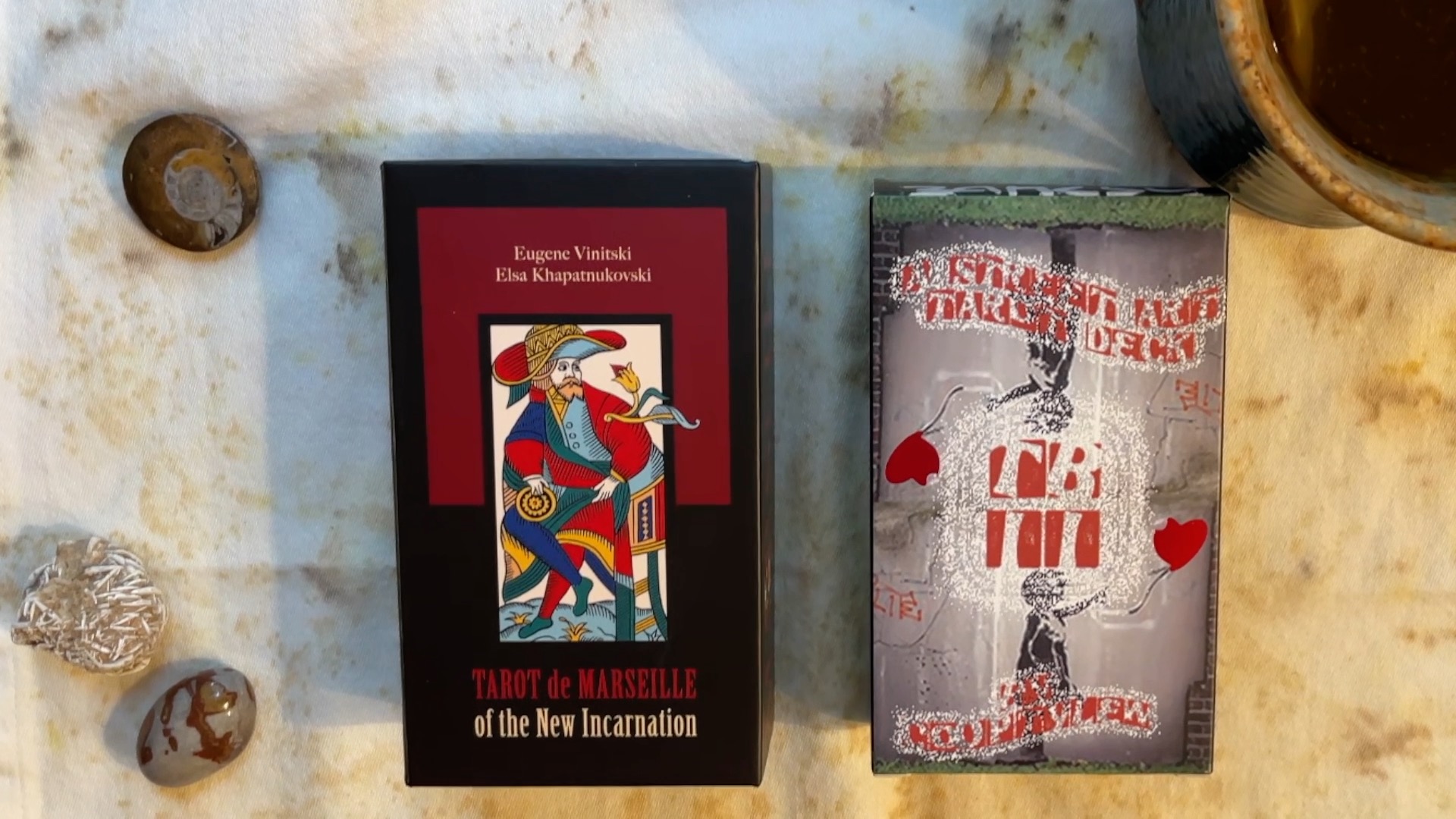
1. Tarot de Marseilles of the New Incarnation by Eugene Vinitski and Elsa Khapatnukovski
I specifically requested this deck as a gift a couple of years ago. At the time, I was on the hunt for a “true medieval deck” and this one, with its premise to pair Marseille interpretations with illustrated folk tales of the time period, sounded authentic.
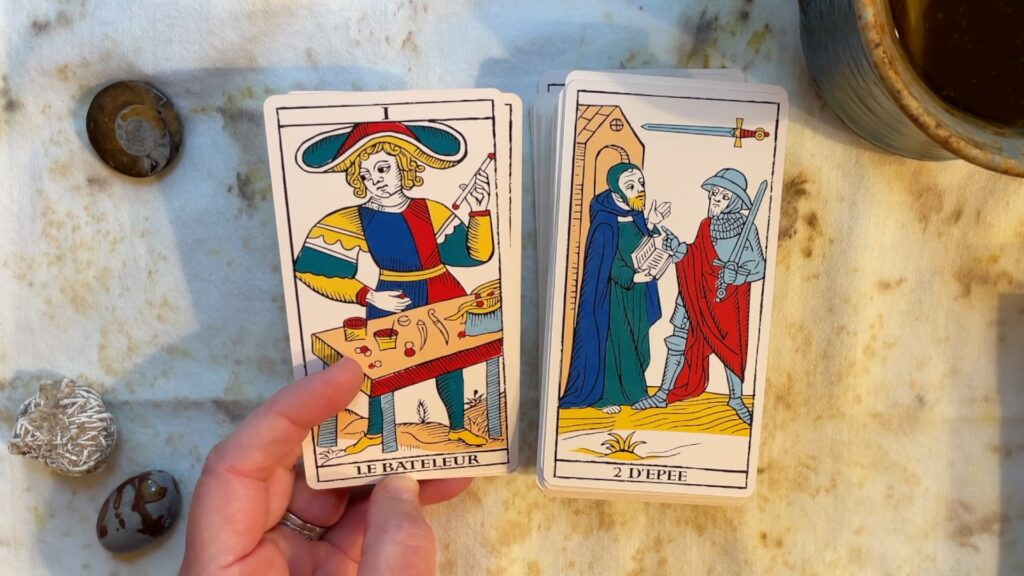
Unfortunately, I should have realized that “myth & legend” decks and I just don’t get along. There is too much information to learn and recall in the full story of each card. While I enjoy a good folk or fairy tale, recalling these in the context of a reading doesn’t seem to add much to the interpretation. Or at least, not significantly enough to put in the bother to learn all the tales. I seemed to understand this with The Mythic Tarot, Spirit Halloween Tarot (for which a friend and I wrote an entire guidebook), Tarot of the Divine, and Ghosts & Spirits Tarot, but somehow, perhaps because it was supposed to be “authentic period tales” this one felt like it might be different. Alas, it is not.
It turns out that another preference I knew about also inhibits my desire to work with this deck: I don’t care for the primary color palette of traditional 18th century Marseille decks: the shrimp-salad color of the flesh tones, the baby blue accents, the bland yellows. I prefer burnished gold, deep navy, and spring greens. So it’s off to the auction block with this one. Good thing, too, as I have another deck on the way and need a spot on the “Historic European” shelf.
2. The DruidCraft Tarot by Stephanie and Philip Carr-Gomm, illustrated by Will Worthington
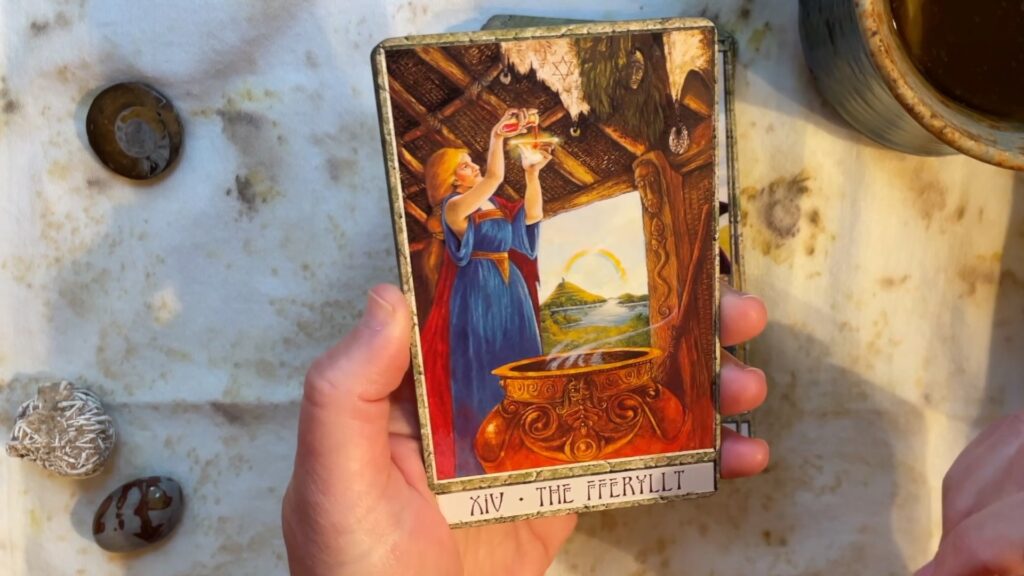
Early on in my search for “the perfect deck” my mother introduced me to this beautifully illustrated work by Will Worthington. I love the rich jewel tones, the expressive faces, and the cultural edit: this deck is based in paganism or revival Druidry, and as such, the Christian symbolism of decks based on the Waite / Smith are replaced with scenes from Welsh and Irish mythology. At the time, this jived well with the personal work I was doing to heal some religious trauma from my extended family of evangelical Christians. Also, there are some sexy naked folks in this deck, which never hurts!
When I first received this deck I didn’t like the size of the cards or the multi-layered borders. The solution to both of those problems was to trim and re-edge it, and I’ve enjoyed using it ever since. However, as my collection grew over the following two years, I acquired decks that had more relatable imagery: people wearing modern clothing and living in homes that look like what we’re used to, rather than bear skins and iron-age round houses. I noticed, too, that when my friends would ask for a reading they’d choose something other than this deck. So it just hasn’t been in rotation, even though I appreciate the beautiful colors and the alternative imagery for some of the “difficult” cards, particularly in the swords suit. I put so much time into fixing the first problem (the size/border issue) that I’m not ready to part with it. I’m going to try to include it in the rotation more regularly and see if reading with it helps me appreciate it more.
3. Tarot Banksy, from murals and other public works by Banksy, compiled by Cooptylew
Four years ago, everyone had a punk deck in their collection: Hexen 2.0, Next World Tarot, Omegaland Tarot, Zombie Tarot. I wanted this, too: something political, something that wouldn’t pull any punches, something that would burst me out of my middle-age, rural-white-lady bubble of comfort and help me confront the brutal reality of life on earth in the 21st century.
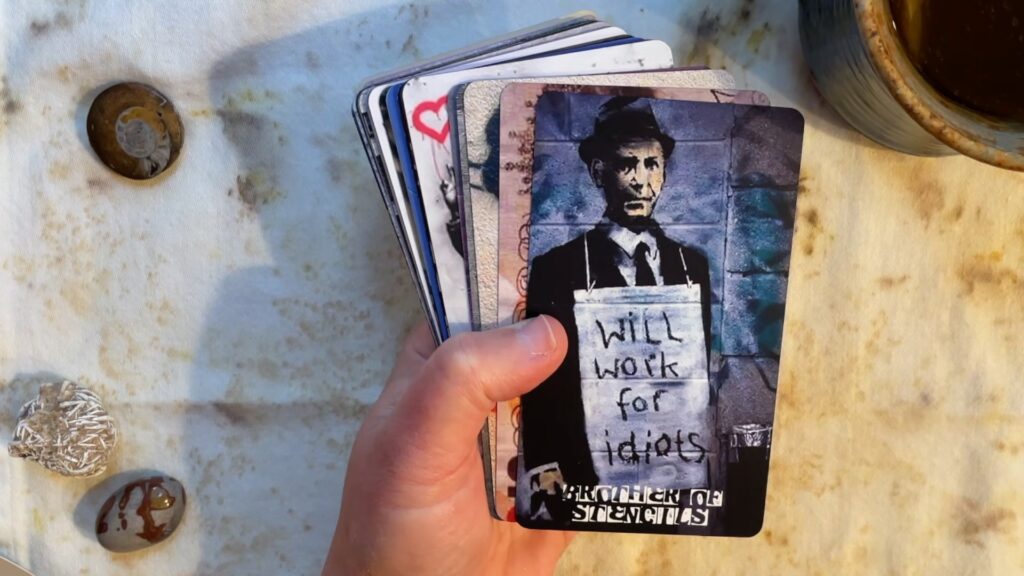
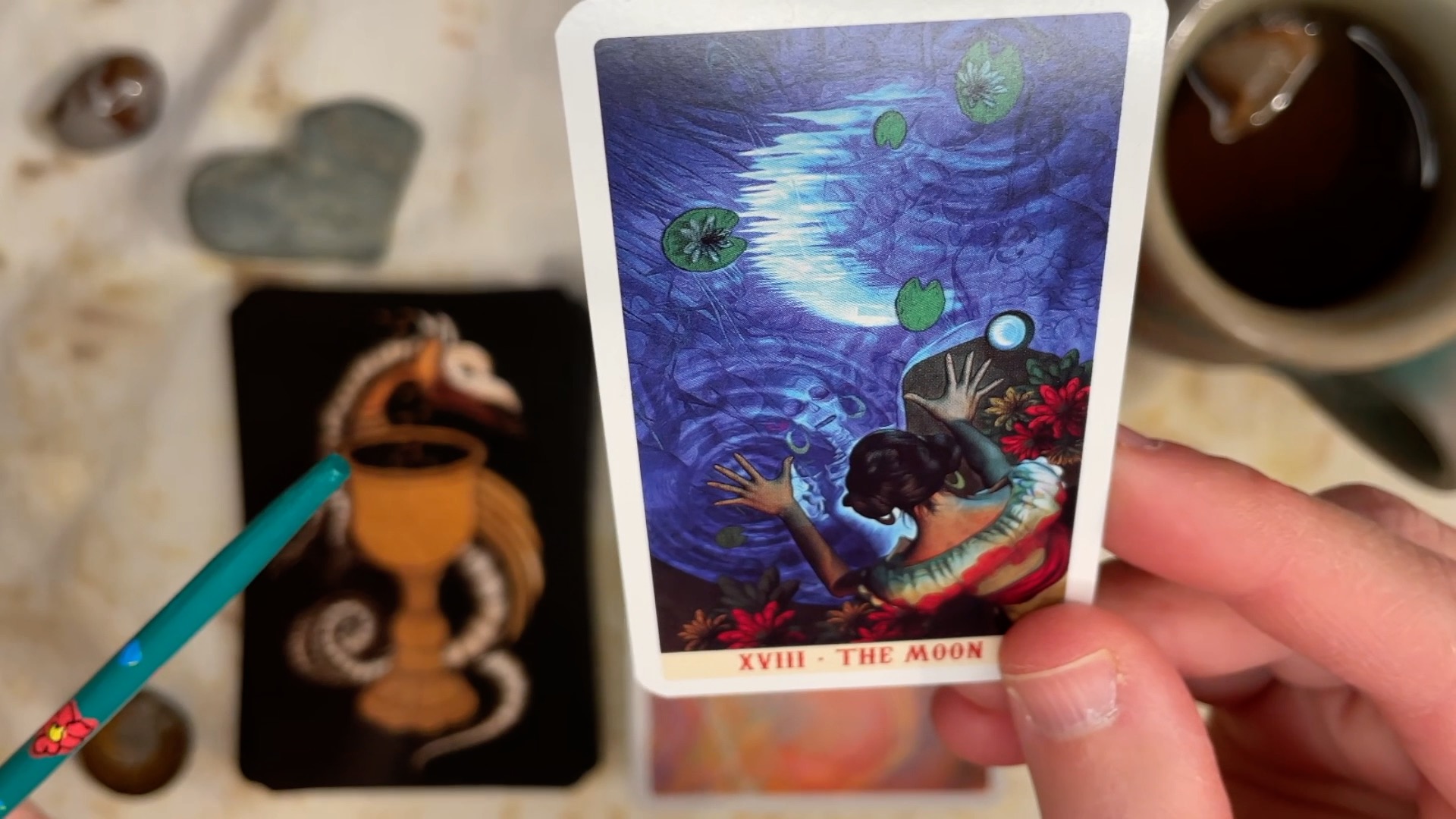
And I found that in Tarot Banksy, where the Hierophant is Pope Jean Paul II wearing the classic Marylin Monroe up-skirt moment, The Moon recalls the car crash that killed Lady Diana in a visual metaphor of Cinderella, and the Papa of Brushes depicts a child soldier holding an automatic machine gun larger than himself. That’s the beauty and problem of the deck: it’s a gut punch, and it’s emotionally difficult to read with. It’s not that I don’t understand the answers, but they are often brutal. I don’t read with this deck for others because I’m concerned one of the many potentially upsetting images will derail the reading, and I’m not inclined to read with it for myself because, frankly, it’s very uncomfortable.
So then I have to consider why I still own this deck, if I can’t use it for its intended purpose. Is it ok to just have it as an art or conversation piece? I’ve sold off or traded other “art decks” that I couldn’t read with: Botan Tarot, Japaridze Tarot, Shimmering Veil. Why keep Tarot Banksy, in particular? Am I just posing as someone who would like to be more politically-minded than she actually is? Am I trying to make an image of myself, for myself? Or is it ok to appreciate the artist’s message without using the deck in the way I originally thought I would? For now, since I still have space, I will keep this deck, and see how things play out. I may be more motivated to give it away in the future.
So, how about you? What deck or decks are sitting unloved on your shelf? What has that taught you, and what, if anything, will you do with that lesson?