Among other functions, tarot and other forms of cartomancy can be a helpful tool for introspection. In reading for myself, I don’t usually ask questions like “what will happen”. I don’t find the answers to those useful, seeing that the answer only pertains to a specific set of influences at a particular moment, and can be changed dramatically based on new events or information. What I do find useful is answers to questions such as:
- How can I approach this tricky situation in a different way?
- What are my choices in addressing this decision?
- How can I best help this person with the thing they’re struggling with?
- Where are my biases and blinds spots, and what am I not seeing?
Essentially, all of this boils down to introspection: the observation of our thoughts and emotions that helps us see through our habits, conventional thinking, and blockages.
Another essential tool for this is my journal. I find that thinking through a situation or problem at the speed of hand-writing (which is for me, very slow) helps me look at everything more objectively. I’ll write a sentence, and then read it back to myself. Do I really think that? Do I believe what I think? What else does this one thought imply? What’s underneath it? All of these questions are easier to answer, I find, when we can take a look at the thoughts and emotions written out in front of us. Keeping them inside our head can keep us spinning around on the same track, or stuck in a tangle of half-truths. One of my teachers, Pema Chödrön, often talks about “ventilating” a problem. We have to acknowledge it, breathe some air and space into it, and be willing to just witness it before we try to “fix” anything. This is what journaling (and reading the cards) helps me do.
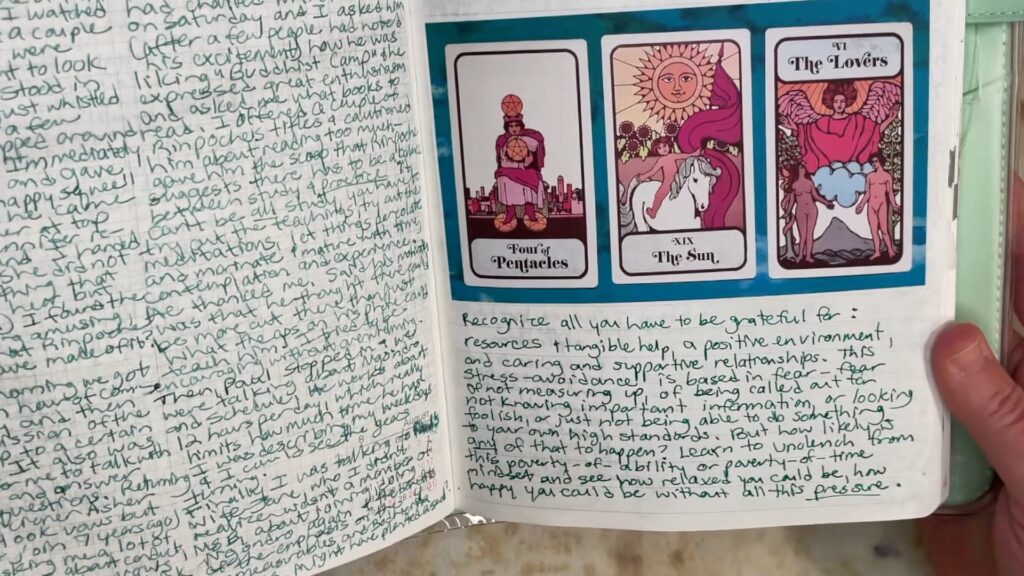
Of course, you don’t have to use pen and paper. Some people find handwriting draining, painful, or need assistive technology to record their thoughts. So whether you’re using a keyboard, voice-to-text, or perhaps voice recordings that you listen back to, some form of getting your words out of your own head so you can scrutinize them is what I’m referring to here.
Personally, I also like to use creative journaling for memory keeping. I have a terrible memory, and as I started to ease into middle age, I realized there were whole years where I couldn’t tell you what significant events took place in my life. It’s not amnesia; if someone were to prompt me and say “remember when you…” I would probably be able to locate that memory. It’s just the initial recall that’s so difficult. I don’t have a good sense of what happened in which year, or in which order. So I decided I wanted to find a way to record some aspects of my life: activities, ruminations, ideas. Not a complete record of everything I’ve ever done or thought about, just some general clue as to what I might have been doing or thinking 2, 3, 5, 10 years ago.
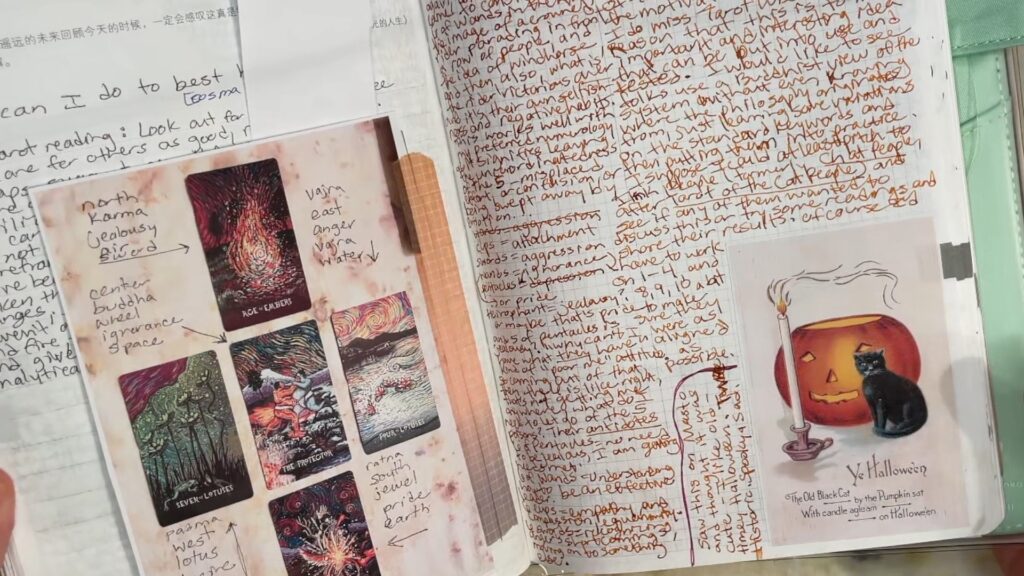
I have tried journaling off and on for years. It never stuck before, and I understand now that’s because I was being too limiting with myself. I was trying to keep a “farmer’s almanac” style journal, but that got repetitive (with an office job, a stable partnership, and no children, life isn’t always variable in the day-to-day). I don’t always want to do a deep-dive into my emotions and fears. I don’t always have time for elaborate scrapbook pages. I don’t typically want to keep to-do lists, but sometimes it’s fun to see what I was up to on a particularly busy week. I like to record my tarot readings, but I don’t read every day. I enjoy writing about our travels but we usually only have one or two trips per year.
Finally, it occurred to me I could put all of that content into one book, an anything-goes, free-form art, dear-diary, tarot record, organizational list-making, ideas for creative projects, scrapbook and travel journal all in one. Dated, so I feel motivated to check in every day (or every couple days), but open in terms of the page layout.
By giving myself the right combination of structure and flexibility I’ve been able to keep up with near-daily journaling since 2022. The tremendous satisfaction I feel knowing I can look back at my old journals and see what I was doing and going through is a fabulous motivator. I also enjoy writing with different types of inks and markers – these days, fountain pens inked in a variety of colors. And I incorporate stickers, doodles, packaging, and found objects into many of my pages. It just adds a little more fun to the process of getting ready to write.
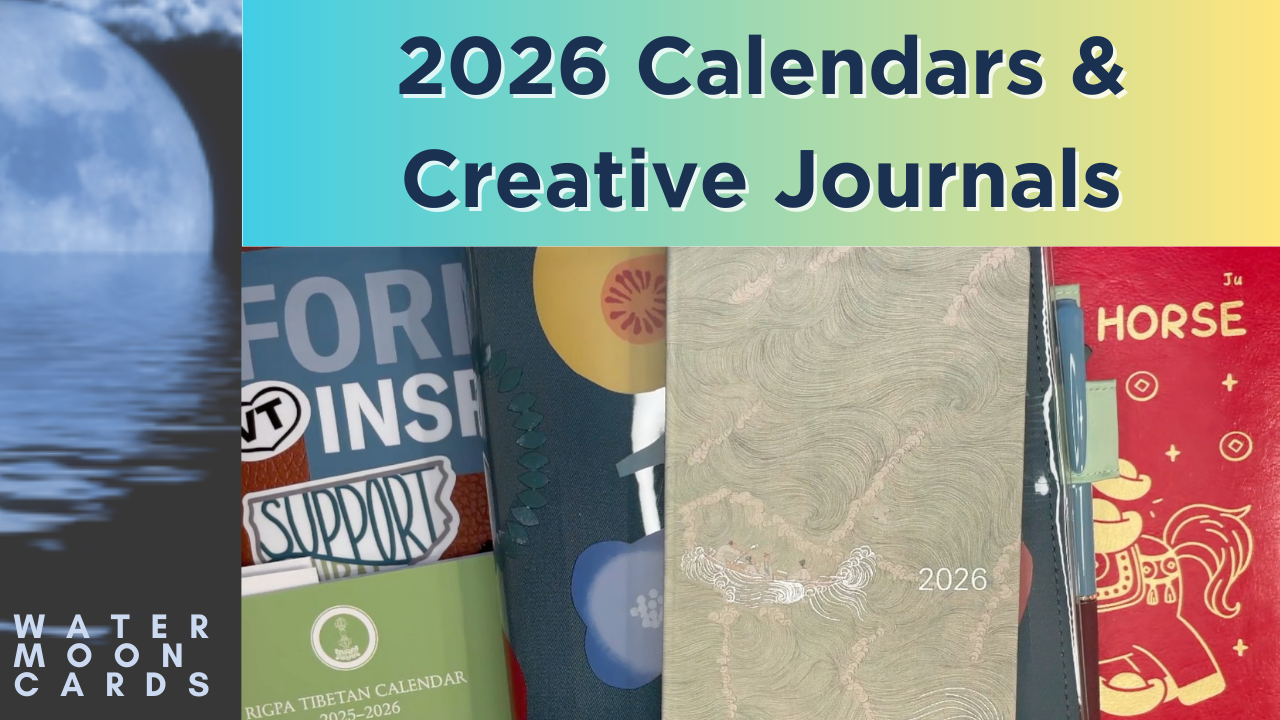
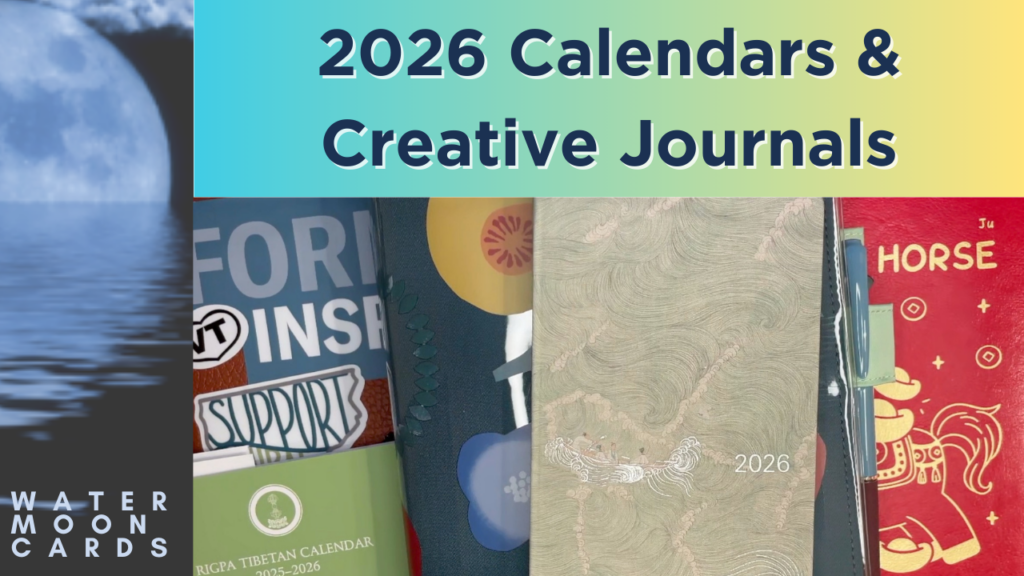
As mentioned in the video, I also use some calendars to track health, holidays, and lunar cycles. If you’re curious, here are the tools I’m using in 2026:
Lunar Calendar by Luna Press – Independently published, this is a wall calendar with lunar phases in the astrological signs, moon rise and set, plus photography, poems, quotes and art.
Rigpa Tibetan Calendar – Also independently published, with Tibetan Buddhist observances, auspicious days, feast days, devotional images, prayers, teacher biographies, and event calendars for various centers. Available at Potala Gate.
Kinbor Weekly – A horizontal weekly layout on the left and a page for notes on the right, similar to a Hobonichi Weeks or Leuchtrum B6 slim style. I use this to track my food, supplements, medications, symptoms, and doctor notes for a chronic health condition plus peri-menopause symptoms. It’s portable enough I can easily bring it with me to appointments.
Kinbor Daily – This is my primary creative journal. It’s an A5 size dated diary with a calindex, monthly overview, and simple daily pages on a grid layout. There are a few extra notes pages in the back for lists, projects, and tracking.
I order both of the Kinbor diaries from AliExpress as they are not available from other suppliers in the U.S.
If you use a journal or diary, tell me what you use and what types of content you like to create or document.