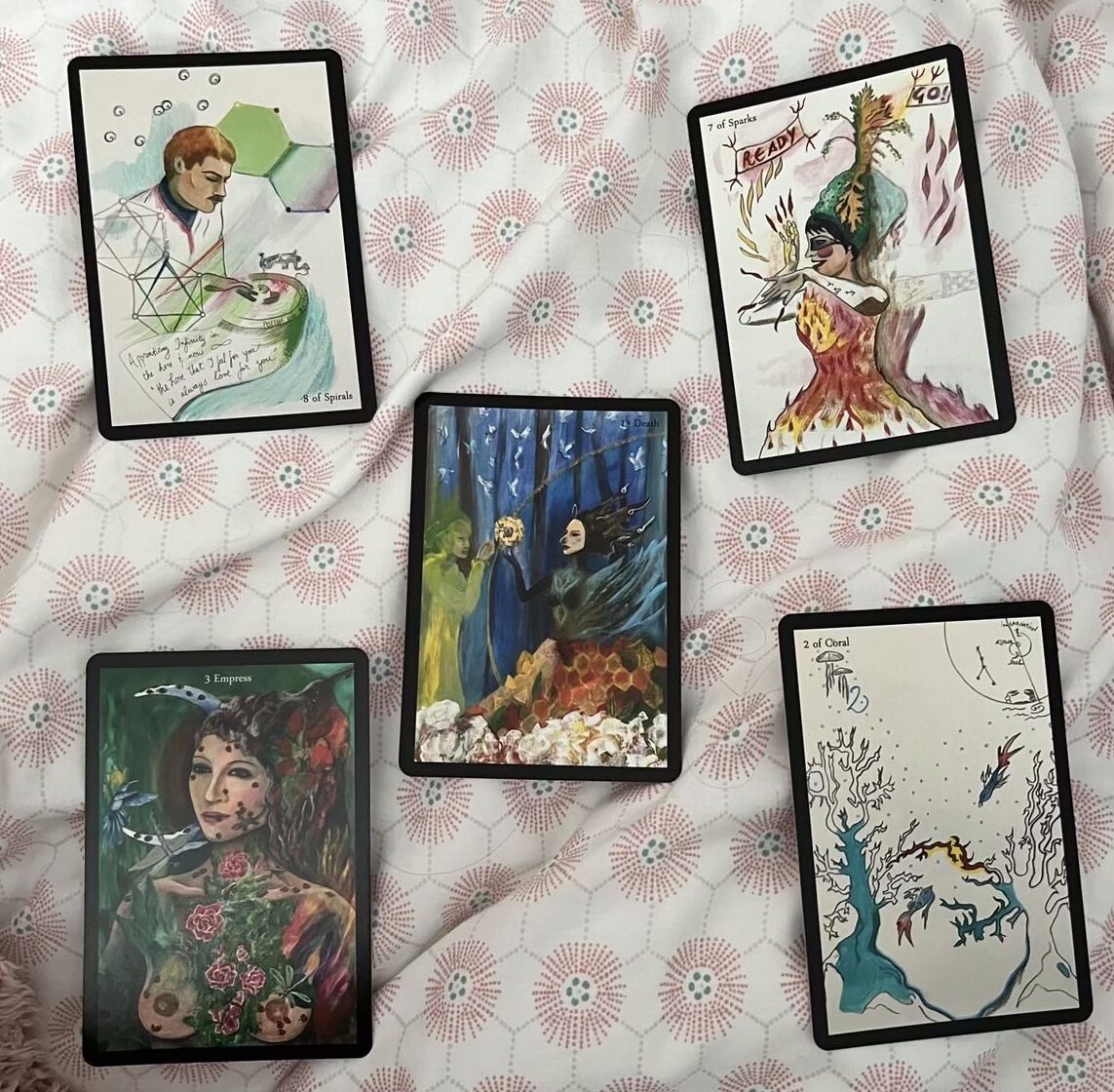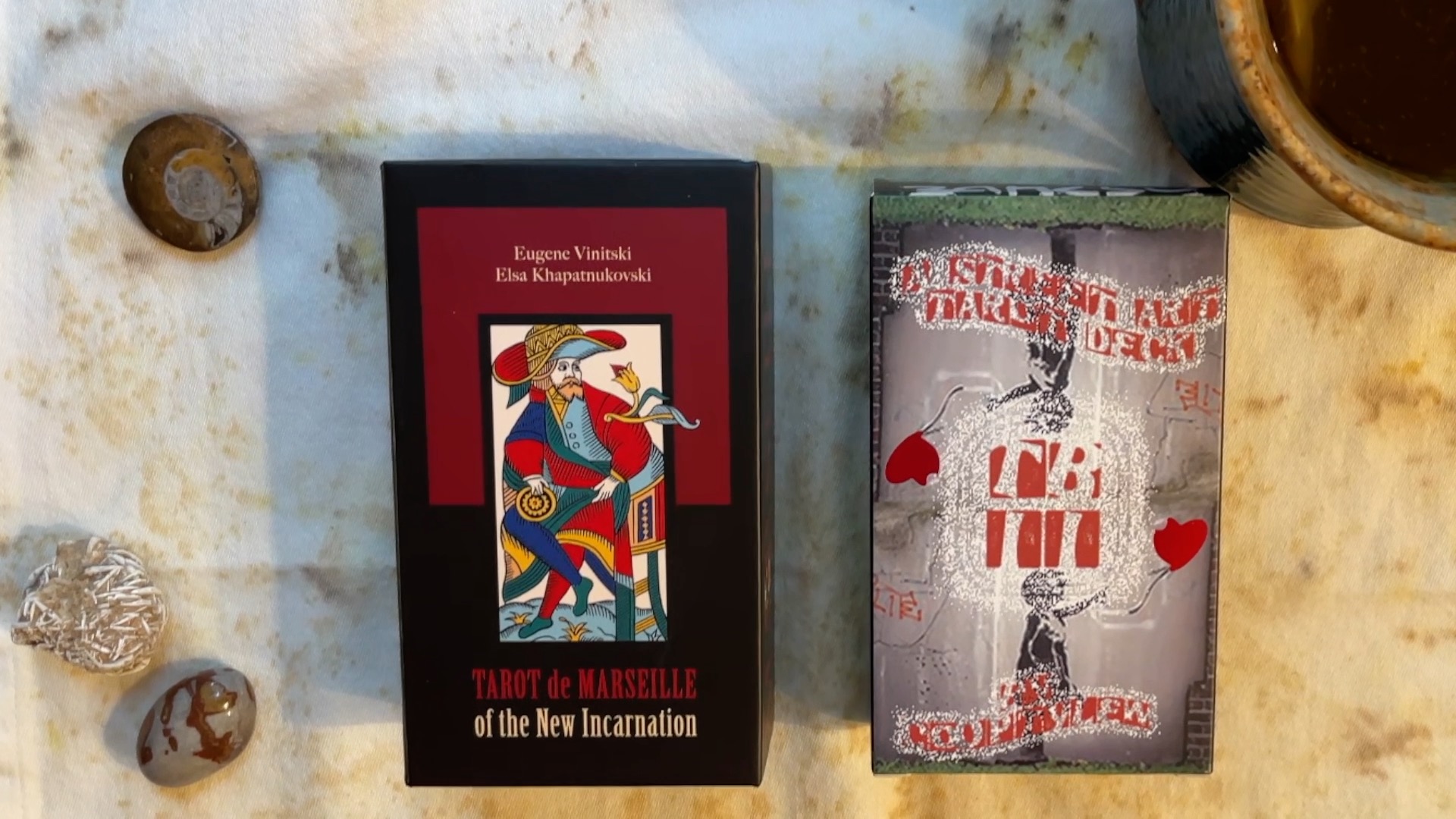
I found this set of prompts through Laura of Aquamarine 18 Tarot and Books, which was a response to Coyote Tarot. It’s quite a long list of questions, so I’ve broken it into separate posts and videos for each of 4 topics.
6. Do you use oracle with tarot?
Occasionally. As mentioned in the video, I find most oracle decks to be rather trite, repetitive, and appropriative. I do have a few that I like, which are either just images, or images with a short title.
7. How many decks do you have?
It’s been a while since I counted, and I was surprised by these numbers!
- Tarot: 70
- Oracle: 6 (including one oracle/tarot hybrid)
- Playing Cards: 6
- Lenormand: 2
- Storytelling: 1 (The Helpless Doorknob, A Shuffled Story by Edward Gorey)
- Parlor-style fortune-telling deck (similar to a Sibilla): 1
8. Where do you store your decks?
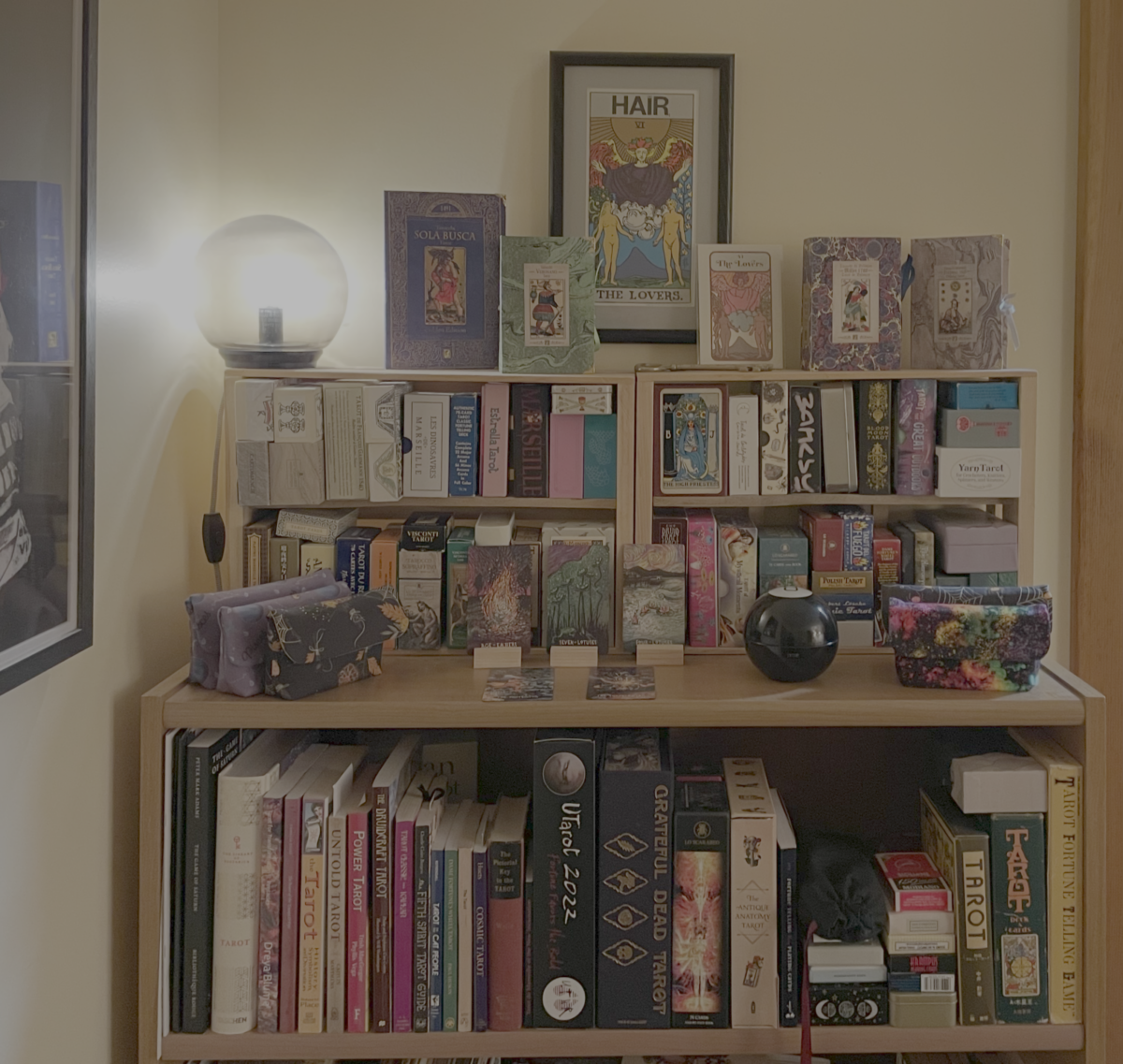
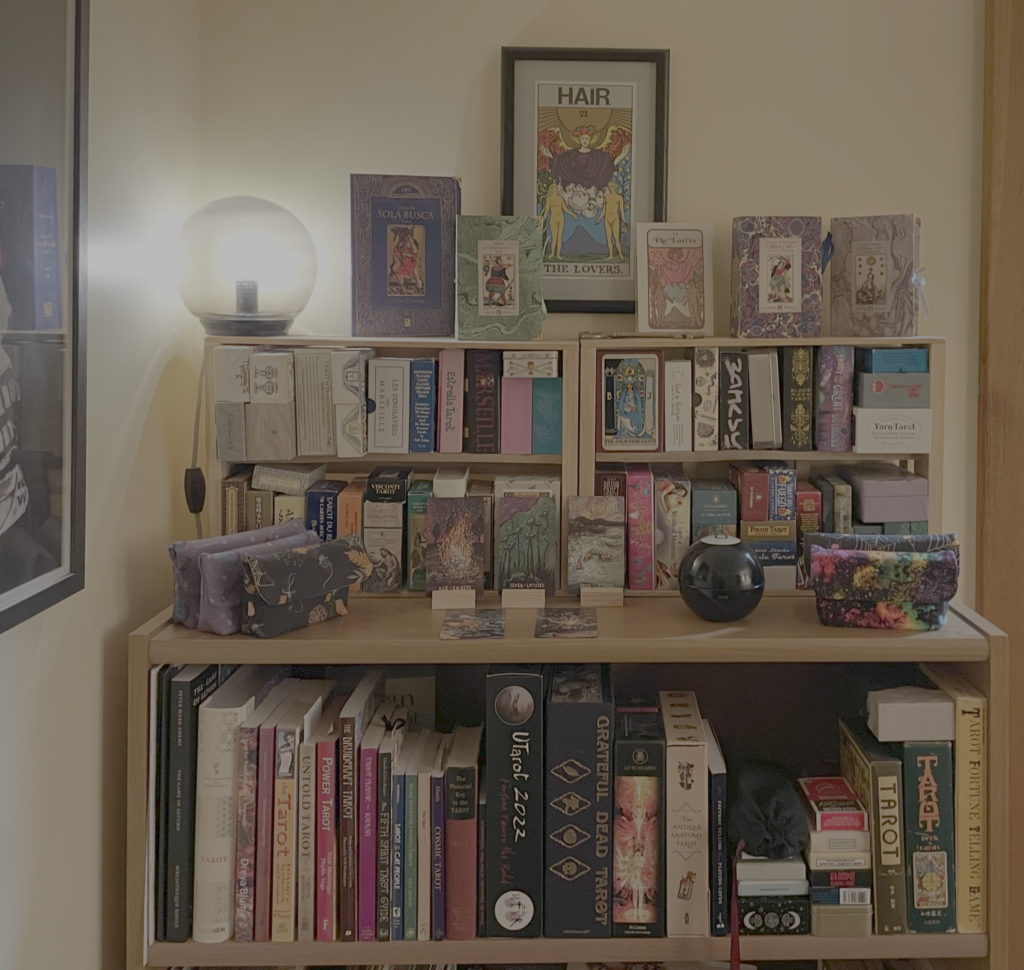
I have a bookshelf in my study that houses a few collections of things: knitting and fiber craft books, children’s books, and my card collection and reference books. My partner made some extra shelves for me that are shallow and sit on top of the bookcase, which works well. This way I can store most of my decks like books in a library (spines showing) and see everything I have at once.
I do also have a few card wallet-style pouches that I use for decks that don’t have boxes. I also use these for decks that came in oversized boxes, like Grateful Dead Tarot and Antique Anatomy. I’ve learned that if the cards aren’t easy to get to I won’t use them.
9. What do you look for in a deck?
It depends on the time period or genre. In most cases I like decks where the people are shown in active scenes, expressing themselves through body language and faces that can be interpreted in a variety of ways. It’s hard to describe exactly what I mean here, but basically: I don’t want the action to be so specific that I struggle to interpret cards in a positive, neutral, or negative way given the context. On the other hand, I don’t want the faces all staring right at me with bland expressions. The Spanish Tarot by Fourner is a good example of a historic-style deck that does this well, and the Gaian Tarot is a modern one that I find easy to interpret. I enjoy working with both pip (symbolic) and “RWS” (scenic) styles for the numbered cards.
For historic decks I prefer card stock that doesn’t feel like casino cards – something more waxy or papery to look and feel historic. I prefer a gently-restored deck when the original source material is too damaged or oxidized to show the images well, for example I never got a facsimile of the Viéville because the original is in such terrible shape.
For modern decks, I like pip decks with lots of color or unusual arrangements; for scenic decks, a different take from the standard Waite / Smith or Crowley / Harris arrangements and poses. Diversity of representation is also important to me – I want modern decks to reflect the modern world in all its rich variety.
When considering a new purchase I carefully consider what place it will serve in my collection; will it be similar to something I already have? What can it teach me about card interpretations that I hadn’t considered before? I am basically maxed out on storage space, so any additions probably mean letting something else go at this point.
For oracle, in addition to having relatable imagery and keywords or titles that don’t get in the way or sound too “newagey,” I like decks that have a consistent grammar and symmetry. It bugs me when there’s an inconsistency in parts of speech or complimentary concepts. For example, don’t mix states of being (lonely) with adverbs (suddenly), directive verbs (release) and longer phrases (embrace your potential), and if there’s a “joyful” card I expect to see a “sorrowful” one in there, too. That said, I do like keywords that can be interpreted in many different situations, or even words that can be either a noun or a verb depending on context.
10. How would you describe your deck collection?
My tarot collection is a multifaceted slice of history through time, excluding most “esoteric” authors (e.g. Papus, Crowley) simply because I do not care for the artwork and don’t use their associations (Kabbalah, astrology, etc). I’ve got historic decks and modern re-colorations from Italy, France, Belgium, Switzerland, Germany, and Spain, and modern decks from artists in the U.S., England, France, Germany, Poland, and Japan.
For oracle, decks that can help me clarify the question (for myself or the querent) or support a tarot reading by providing a summary or suggesting a next step are helpful.
11. Do you have a go-to tarot and oracle deck?
For tarot…kinda? If reading for myself it depends on the topic, but I use Margerete Petersen a lot and also Gaian Tarot and Mara Lunne. For friends or clients I’ll bring a mix of styles and let them choose.
12. Do you re-home decks? If so, what determines if it leaves your collection?
I did this a lot in my “acquiring phase” in 2021-2023. I’d get locked in to curating a mini-collection and buy everything I could find in that area (1970’s decks, board game decks, Japanese tarot, hybrid decks, historic decks from places other than Italy and France, etc.) I wasn’t just amassing things to collect them, though, I was fascinated by how different art could affect a reading, and also why artists of the past made the choices they did.
As my understanding of tarot history grew, my tastes refined and I started downsizing in a big way. I sold a lot of items on eBay, and also participated in tarot trades via Facebook groups (only had 1 bad experience there, and many good ones). I gave decks to friends, and also traded or gave decks to people I met through their YouTube channels.
I re-home when I feel like a deck doesn’t have much value for me: I don’t enjoy the artwork, don’t find it easy to read with (Botan Tarot was like this: gorgeous but I just could not get anything clear out of it – broke my heart), have some kind of beef with the author (e.g. Crowley, et al) or have something else in a similar style that I prefer. For example, the Mara Lunne Tarot replaced 7 other decks in my collection, because it met multiple criteria that I’d been looking for and hadn’t quite found up to that point: “RWS” without the standard poses, neutral imagery for open readings (no “bad” or “good” cards), watercolor style incorporating lots of colors, diversity of settings and humans, and good card stock.