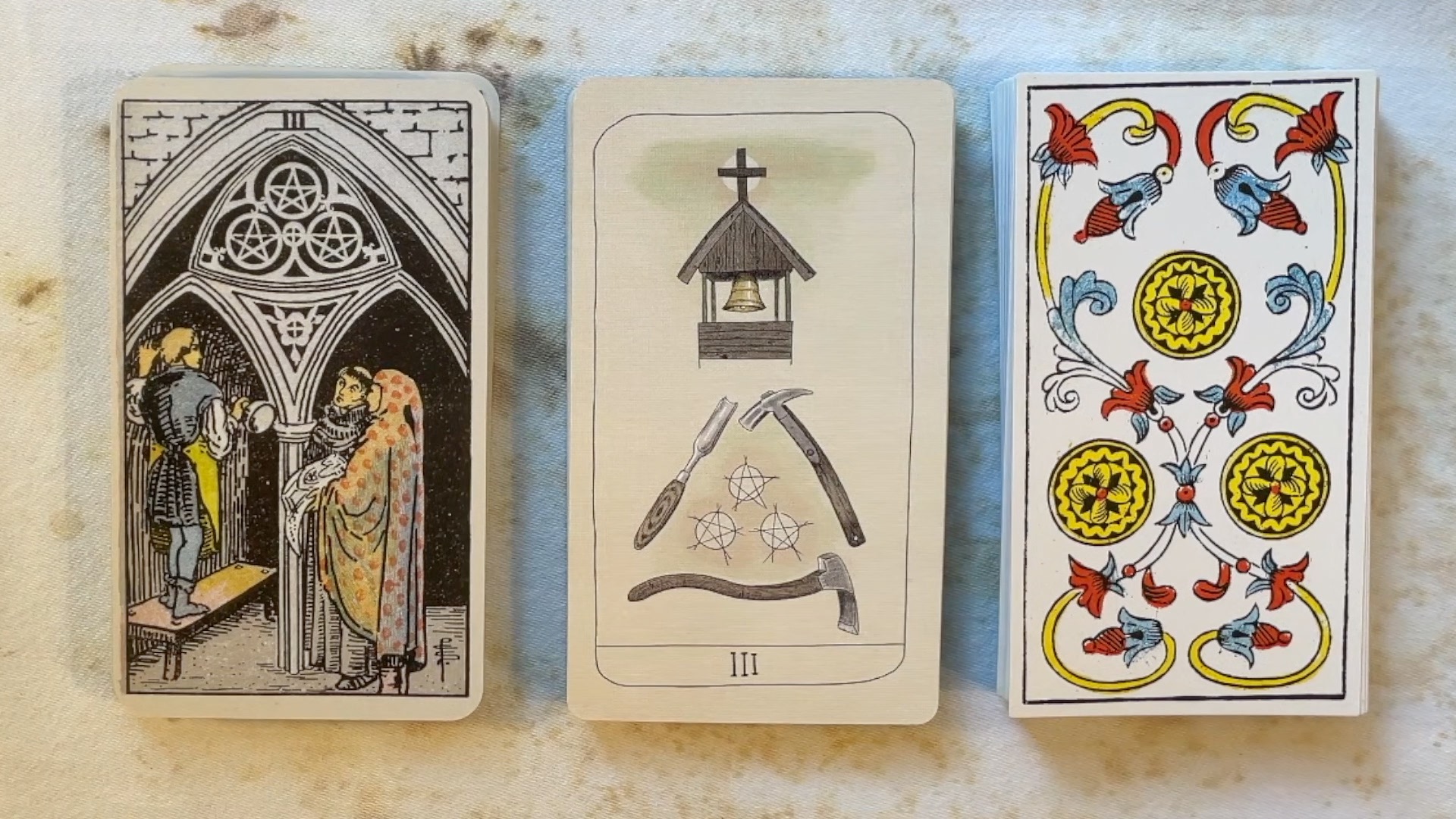
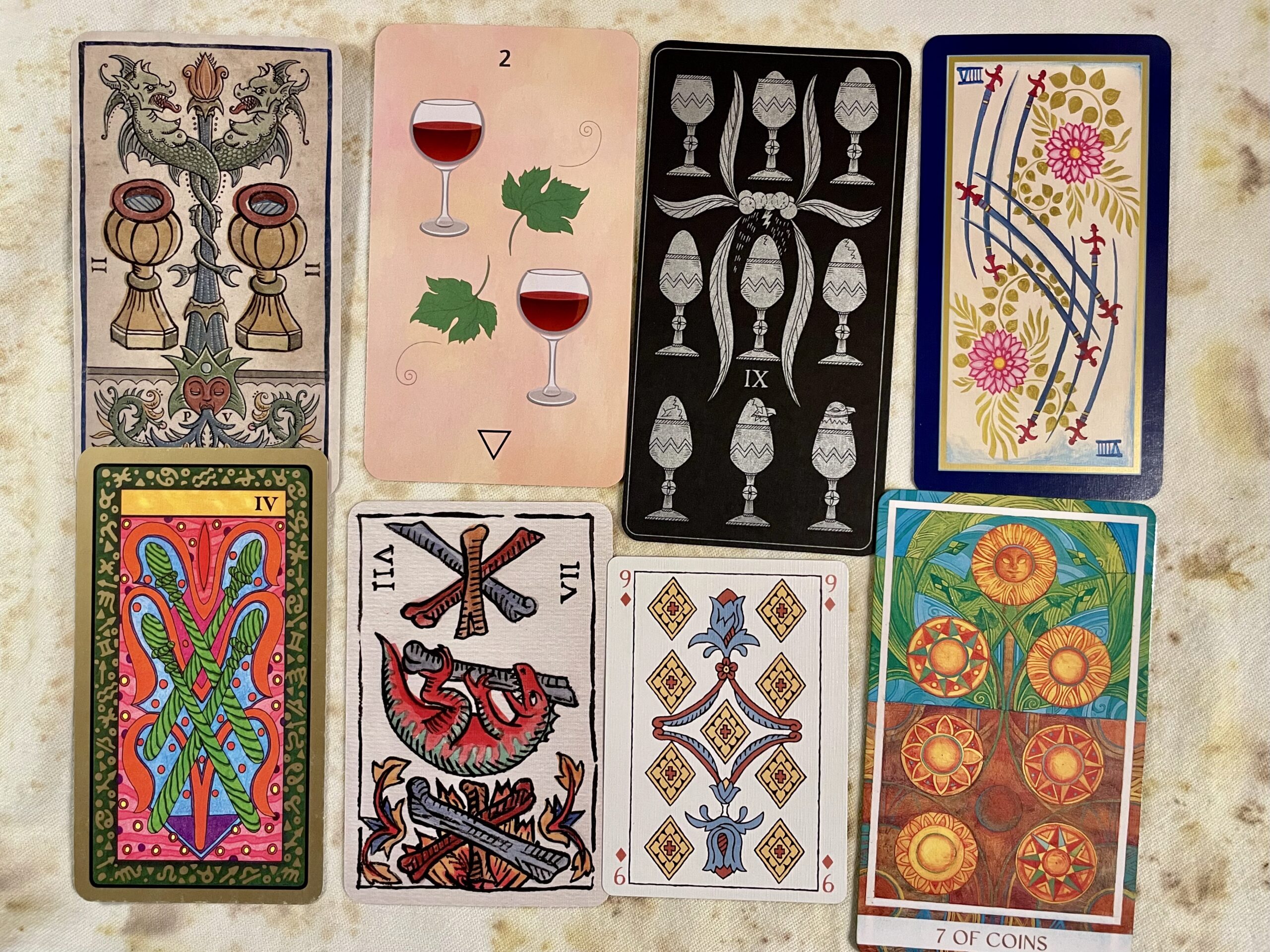

I like weird pips, and I cannot lie. You other readers can’t deny that when a deck presents asymmetrical pips and some unexpected shapes you get…
Sorry about that – just seeing if anyone’s reading the blog. But I do like weird pips: unusual patterns that differ from the traditional Visconti / Marseilles-derived arrangements; alternate objects; funky backgrounds and florals.
I wasn’t necessarily going to call all of these out in a video, but when all your buddies are having fun, of course you want to jump in, too! And this gives me the opportunity to showcase some decks in my collection that have taught me about reading and interpretation, but don’t fit into another category. Here they’re listed in the order that I showed them in the video.
Trionfi della Luna, Patrick Valenza, Deviant Moon Inc. 2019
I showed two colorations of this deck – the original with beige backgrounds and earth tones, and one of the inverse colorways: paradoxical blue, which looks to my eye like colored chalk on dark paint. I love the way Valenza blends together Italian, Besançon, Rouen-Brussels, and Parisian tropes. He’s created a wacky, melancholic, humorous and fantastical deck that includes references to the works of Hieronymus Bosch, Pieter Bruegel the Elder, the absurdist films of Terry Gilliam, and other influences. The weird little touches in the pips add to the overall character of this work.
The Crystal Tarot aka Tarot of Glass, Elisabetta Trevisan, deluxe version LoScarabeo 2025
I’d been holding out for a better production of this deck and it finally arrived! The art style blends medieval, pre-Raphaelite, art nouveau, and art deco beautifully in a rich palette of jewel tones. The pips relate to the Eudes Picard interpretation, with some variation.
Ina at Taproute Tarot has a detailed video about Eudes Picard and some other decks that use this pip arrangement.
Tarot du Roy Nissanka, Maria Mestre, Grimaud 2011
This exquisite pack is based on the art of the kingdom of Nissanka Malla in the late 1100’s in what is now Sri Lanka. The pips do not follow any particular historic arrangement but add in delicate touches of ferns, flowers, and gold paint.
Rare Triumphs, Ian Cumpstey, Skadi Press 2021
Ian’s inventive Marseille + playing card hybrid features many renamed majors and beautiful geometric pips that blend Marseille arrangements with textured French suits. I find this deck reads in a sharp, direct manner; perfect for getting no-nonsense answers.
Polish Tarot, Aleksandra Jasniak, self-published c.1995
Technically out-of-print, it seems the original artist has a few remaining copies left for sale in her Etsy shop. I got my copy second-hand a few years ago. The card stock is thin and what some might call “flimsy” but it’s a dream to shuffle. I love the bright 1980’s colors, the psychedelic backgrounds, and the subtle symbols. The pips are not arranged according to any particular tradition, which makes reading this deck extra flexible.
Inspired Soul Tarot, Juli Rose, self-published 2020
Conceived as a deck for inspiring one’s creative imagination, I find the simple symbolism also gives very clear readings on mundane and common subjects. The suits are aligned elementally and numerologically (buttons = earth, paint brushes = fire, wine glasses = water, fountain pens = air) with plenty of space to open up the reading.
Check out Juli’s walkthrough of Inspired Soul, and this and other decks on her MPC shop.

Dinosaures de Marseille, Anastasia Kasian, self-published 2018
Dinosaurs, fossils, unusual pip arrangements, elemental associations, a Minchiate-inspired expansion pack, and a sense of fun and joy – what more could you want in a deck? I appreciate the effort that Kashian has put into researching and selecting various historical touches to give her deck depth beyond its seemingly silly surface. In addition to careful elemental and dinosaur links in the minors, the pips are arranged in what I’m calling a Lombardic pattern, one you’ll also find on the anonymous Tarot of Paris c.1650, Tarocco Neoclassico aka Tarocchi Lombardi 1810, the modern Tarocchi by Michaelangelo Rosato, the Tarot of Musterburg by Curio & Co., and, of all places, the Labyrinth Tarot Deck illustrated by Tomás Hijo.
Le Tarot de L’étoile Cachée, Elisa Seitzinger, Sabat Magazine 2020
How many adjectives apply to Seitzinger’s brilliant vision for a tarot deck? Insightful, funny, naughty, political, cheeky, demanding, playful, derisive, relatable…. yes. The material quality of the cards mean this is more of a museum piece than a working deck, but I’m still so happy to be able to study and learn from its witty humor and insightful critique of our current culture. Big thanks to my mother for allowing me to caretake this surreal and spunky work of art.
I Naibi di Giovanni Vacchetta, created 1893 in Turin, hand-painted by Osvaldo Menegazzi and published by Il Meneghello, 2001
A skilled artist in interior design, sculpture and decorative arts, Giovanni Vacchetta created but never officially published this deck of cards. Possibly this was just a personal creative exercise for him? Ahead of his time, many of the pips feature flourishes and small scenes that hint at their cartomatic interpretation, 16 years before Pamela Coleman Smith’s designs for the Rider Waite pack were first printed.
I appreciate all of the visual clues and metaphors hidden in the pips, particularly the Bastoni, and the court cards are some of my favorites of any deck. If you’re at all interested in learning to read with a non-esoteric deck, this would be a fantastic one to start with, in my opinion. It has been published in several different versions, including a mass-market colorized option by Sirio and a linework-only edition in Lo Scarabeo’s popular Anima Antiqua series of historic reproductions.
Thanks for checking out my top non-traditional pip decks. I’d love to hear what yours are! And of course, a big thanks to Moom In Tarot for starting us off and compiling the #TopTenPips playlist.