
When I first realized that tarot predated the Smith-Waite deck of 1908 I was immediately excited to start collecting historic decks… and then quickly put off by the crude, primary color woodblock style of Tarots de Marseille. After additional research I started to find recolored and redrawn decks that I preferred and have continued to gravitate towards these instead of their original historic counterparts.
Images in the video taken from Healing Oaths (Visconti walkthrough) and Craggy Brook Witchery (Fournier Marseille walkthrough).
Decks shown (in order of appearance)
Tarot Visconti-Sforza (c. 1470), Editions Fabbri and Lo Scarabeo, 2000, 2002; redrawn by A.A. Atanassov, booklet by Giordano Berti
Mamanmiyuki Tarot de Marseille, 2013 based on Pierre Madenié, 1709 (misattributed in the video to Nicholas Conver, 1760, which is similar).
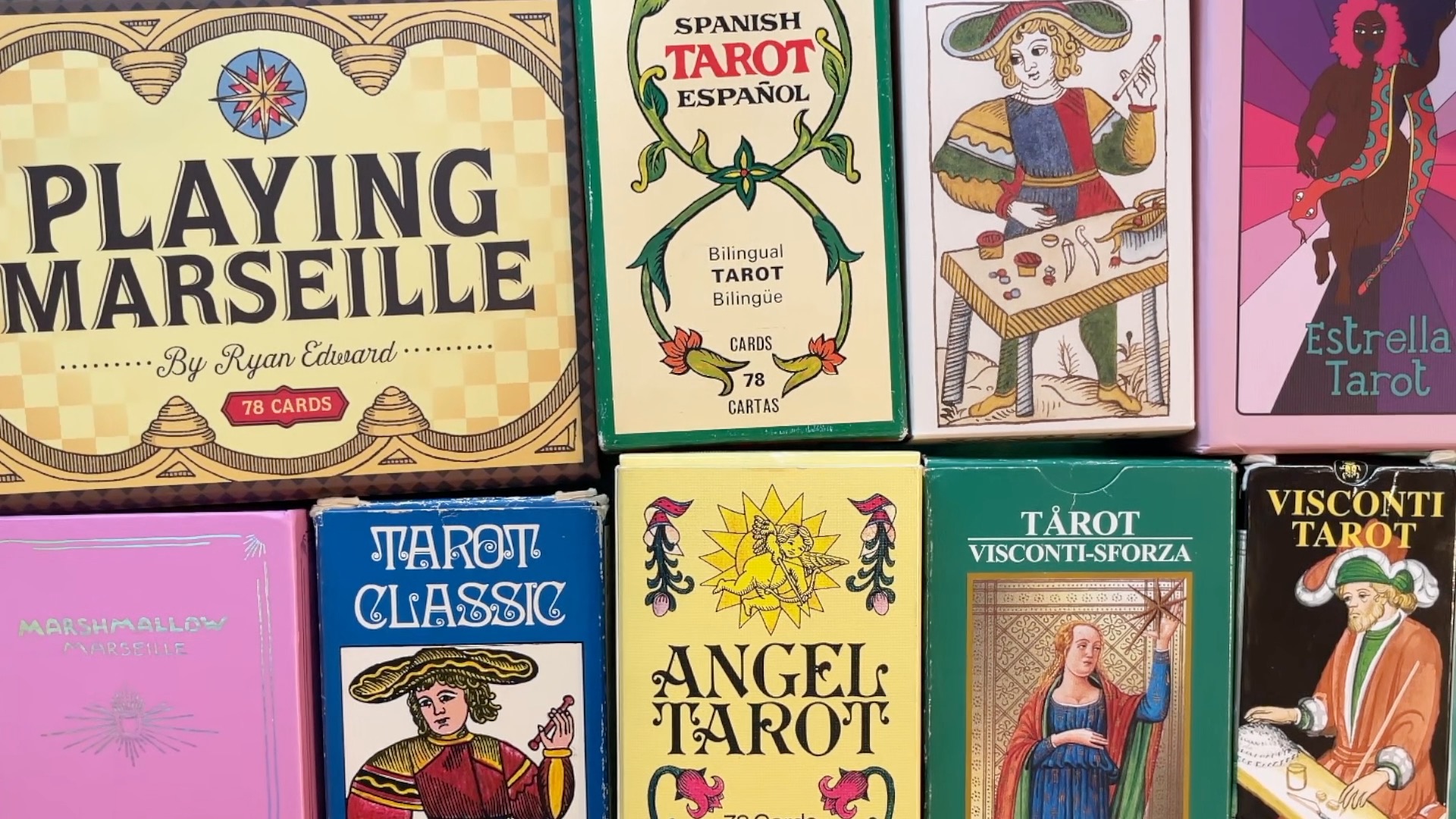
Playing Marseille, Ryan Edward, U.S. Games 2020, based on Jean Dodal, 1701.
Estrella Tarot, Ash la Estrella, 2022, based on Jean Noblet, 1650.
Ina of Taproute Tarot has a more extensive video about this deck.
Tarot Classic, U.S. Games & Stuart Kaplan 1974, based on J. Muller, originally printed by Schaffhausen & Hasle c. 1905.
Angel Tarot, Angel Playing Card Co. & Stuart Kaplan, 1980, based on Claude Burdel, 1751.
Marshmallow Marseille, c. 2017, Wandering Oracle (Jorge Cuaik), based on the Valla Tarot from Trieste, 1790. Interview with the artist.
Spanish Tarot, Fournier & Stuart Kaplan 1975, based on Guiseppe Ottone, 1736.
Tarot de Maria Celia, Lynyrd-Jym Narciso, U.S. Games, 2018, based on various traditional tarots.