
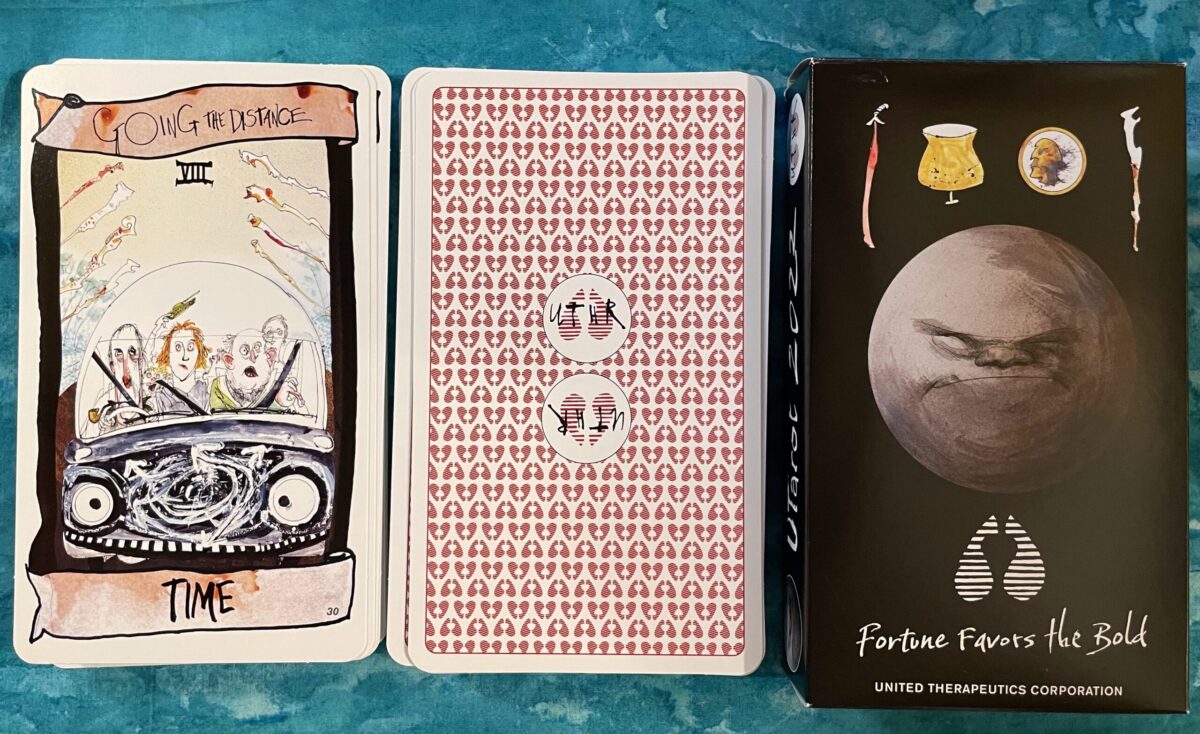

UTarot 2022, custom work created for United Therapeutics Corporation. Art direction and tarot instructions by The Tarot Lady, Theresa Reed; art by Ralph Steadman.
Welcome to my very long TED talk on creativity, inspiration, and how we misconstrue learning and skill development for talent. Scroll to the end of this post to get to the tarot part.
I’ve been thinking a lot about creativity lately, after several related conversations with various friends; all of them are perplexed about how creativity and inspiration and how learning work. And I’d say it is true for learning anything new that has a creative element, whether that’s learning to read tarot or doing something more traditionally artistic like painting or learning to play music, or even something that’s more like creative problem solving: learning to code, or restoring vintage cars. There’s creativity in all of these and in any active hobby.
My friends have been asking questions and making statements such as:
- How can I find something I enjoy doing, my “passion”?
- I’m waiting for inspiration but it never seems to come.
- How can I get out of a rut and feeling like everything in my life is just a chore or obligation?
- I see other people doing creative things but I can’t seem to motivate myself to do that or sit down and concentrate. What’s wrong with me?
- I keep trying different things but none of it sticks.
- I enjoy taking classes, but can’t seem to practice on my own.
These quandaries usually combine together with the following excuses:
- I don’t have enough extra money or space.
- I don’t have enough time.
- I don’t want to accumulate finished products.
- I’m bad at this; I lack talent; I’m not a creative person.
These statements and excuses are a product of a common and crippling view of creativity: that it is innate, that it therefore should be effortless, and that if someone does not possess natural talent for a specific activity they will never be proficient. This way of thinking is not only inaccurate it is completely defeatist. I think it has existed back through history, but it seems to have gotten exacerbated by the pitfalls of comparative culture via mass- and social- media. We see not just a few examples of artistic proficiency now; they seem to fill our feed. And often, when we see someone enjoying doing something they have developed skill in, our reaction is one of jealousy: “I could never do that”, or “I wish I could do that”.
But, it is not about talent. Creativity is a process that can be expressed in a sequential equations:
- Repetition + Concentration = Skill Development
- [Skill Development + Curiosity] x Time = Creative Flow + Discovery of Ideas (aka “inspiration”)
The feeling of mastery, that is, being able to use the instruments of craft seemingly without effort is only developed with a lot of time and effort. I think mastery is what people are referring to when they say someone is “talented” – they have mastered their craft to the point that it no longer looks like hard work; it just looks like fun, or pure expression.
Here’s the thing, though: learning how to learn something new is its own skill. If you haven’t learned anything new from the beginning in a while, it will probably feel somewhere between uncomfortable to impossible at first. And it’s unlikely to feel “fun” for a long time. Judging things based on whether they are easy or fun is a lie of capitalism and colonialism. We are taught to buy our way into creativity: buy these supplies and that class and you too can be a creative wizard! We’re told that most creative people (the ones we see on social media) are “gifted” or “naturally talented” or “born a prodigy”. And sure, there are people who discover an affinity and ease for something at an early age; it is rare and therefore garners a lot of attention when it happens. (Yo-Yo Ma first made his national television debut at age 6. How many people in the world get to do this in your lifetime?) For most people, “discovering” creativity is not a matter of luck or natural ability. It’s a result of hard work and dedication.
I want to take a moment here and address ability and ableism. Some activities take a certain level of physical capacity to perform. Many of these physical capacities can be practiced and learned: how to fret and strum a guitar at the same time, how to dribble a basketball, how to make different strokes with a brush. Some types of activities require levels of able-bodiedness: knitting, playing a two-handed instrument, or using certain types of power tools safely are examples. There may be variations or adaptations for the thing you want to try, or there may not be. These days, if someone with your disability is doing the thing you’d like to do, they have probably made videos about adapting the equipment or technique to their body. The internet is your friend here for figuring out what solutions others have developed or adopted.
So then, how does a normal, average, “not talented” person like you or me discover their creativity? We need a guide. This is the one I’ve developed across decades and various creative hobbies.
Roadmap to Mastery
Just start. Stop reading books about and watching videos of other people doing the thing you want to do at a level that you may never achieve, and pick up the thing and start. As you begin, figure out some way to arrange your daily schedule so you can set aside at least an hour of time to concentrate on practicing this new skill. Or, if you can’t practice every day because of logistics (maybe “open skate” at the ice rink is only available two days per week), then at least create some kind of regular schedule. Learn how to stick to this schedule, whether or not you feel like it. Learn how to say “no” to excuses and distractions: the invitation to get together with a friend during practice time, the requests from family or work to drop everything and help with a their fabricated priority, the temptation to spend practice time shopping for your hobby or reading about your hobby rather than doing your hobby. You will never make any progress if you do not practice with diligence and consistency. Are you going to allow yourself to be stuck in beginner-level purgatory out of shear laziness?
Recognize and accept that you are going to suck at this new activity at first, and for a long time. And I mean, really suck. Your solder points will fall apart, your colors will run together, your pottery will fold on itself or crumble to dust. Your threads will tangle, your machine will get jammed, you’ll fall on your face and skin your knees, and the only noise you’ll be able to make on that musical instrument will be some variant of “tortured cat” or “fart-o-phone”.
The desire for instant ability is what makes many puzzles and video games so addictive. Scientists have figured out the perfect ratio of challenge to dopamine hits that make us want to keep playing: one more level, one more bonus round, one more character upgrade. But learning something on your own doesn’t feel this way – you fail constantly. There are no high scores, no bonus rounds, not even a hint or clue as to what to do next, sometimes. Learning is difficult and frustrating.
The trick is to view these early experiences as experimentation instead of failures to achieve. You are learning to do something. You learn by trying, failing, doing again, failing, doing again. And slowly, with diligence, it goes from feeling impossible to improbable to very difficult to slightly less difficult but still a total slog and why-did-I-decide-I wanted-to-learn-to-play-the-tuba-this-is-so-stupid. Keep going.
Keep reminding yourself, every day, that you are a beginner and this is part of the process. For many people, having a coach, mentor, or private teacher is the best way to get through this period of being a disaster: you need someone who is patient but also pushes you to commit and be diligent in practice. A good teacher understands tiny incremental improvement, and can spot and point out progress that a beginner might miss, being constantly focused on the flaws in their work rather than the subtle clues of improvement, week to week.
It’s easy to get bored and frustrated with sucking at something. No one wants to have to look at their bad art, read their confusing prose, stare blankly at the tarot cards that aren’t making any sense, or listen to their own squeaking and caterwauling. We don’t take up a hobby intending to suck at it; we’d very much like to produce something pleasing, even if it only ever pleases us. And many of us get hung up on this point – we have a very specific vision of what we’d like to be able to do: nail that Jimi Hendrix guitar riff, paint birds the way Georgia O’Keeffe painted flowers, bowl a perfect game. If we can’t do that then we think we’ll never enjoy learning to play guitar, or paint, or bowl. But why do we have to be sold-out-stadium, world-famous-artist, best-all-time level to enjoy something? That feels very exclusive and limiting to me. Maybe we don’t have to be The Best at something to enjoy being Pretty Good.
The good news is we don’t have to hang on to our failed attempts as a beginner: we can wedge our wonky pots back into raw clay before we fire them, paint over that ugly painting, delete the poem that’s riddled with cliched phrases, and forget all the gutter balls and sour notes. We will eventually forget how terrible we were at that thing when we stared, if we can keep going until we begin to develop a level of mediocrity with it.
Improvement is not linear. You’ll have good days and bad, and not all of that is linked with the level of skill you’ve developed. Our neural pathways, hand-eye coordination, and memory take time to develop; sometimes we can really feel the progress and sometimes it feels like swimming through mud. Or, perhaps external things are just off: our machine isn’t calibrated correctly; the weather is affecting the dry time of our paint or the intonation of our musical instrument. Or we’re simply distracted and not concentrating on practice as much as we could be. The important thing to do on these days is to practice anyway. Learn to paint when you’re depressed; to take photographs when you’re bored with your subject matter; to paper-piece that quilt when you’re distracted about the outcome of something you have no control over. If you’re having a bad day, do it anyway.
Solutions to Specific Problems
I don’t have the space, budget, or facilities to do this activity: Partner up with someone who does, offer to help with their project as well as facility maintenance. Even basic cleaning can be helpful and a learning opportunity (activities like woodworking, automotive restoration, pottery-making, sewing, horseback riding, and baking are messy). Or find a group workshop, maker space, or studio in your area where you can store your supplies and works in progress, and make use of shared equipment that is too expensive or unwieldy to own.
I don’t want to accumulate a lot of “stuff”. This one rings true to me as I get older. After living in the same house for 20 years, our wall space is full and so are the cupboards and closets. I don’t want more dresses, sweaters, bowls, quilts, paintings, bird feeders, wall hangings, or other hobby output. The solution here is to pick something that is creatively ephemeral. This would include any form of performance, writing, or physical or mental activity. Learning to tap dance, write poetry, ride dressage, bowl, or play chess are all activities that don’t produce finished objects. Many audiovisual art forms can also be digital-only: photography, painting, drawing, collage, and music production can all be done solely on a computer.
I don’t have enough time. Time does not magically appear on its own, you have to make yourself create it. That will probably mean giving up other activities that you enjoy, or are accustomed to: watching less TV, spending less time doomscrolling or online browsing, or giving up a social obligation that interferes with being regular about practice. Making these changes can feel difficult, especially when we’re in the “I suck at this” beginner phase of learning. After all, why would we willingly give up something we enjoy to pursue something we only think we want to try, but aren’t actually sure about? But without dedicated time, we won’t make progress, and without progress, our motivation to continue through the beginner phase and into developing ability with wither before we’ve seen any reward.
Will This Ever Be Fun?
Perhaps the most difficult question to answer for ourselves when we are kicking the tires on a new potential pursuit is this one. How do we know if we’re going to enjoy something before we’re any good at it? I’m not entirely sure we can know that ahead of time, but I do think there are a couple of things to think about.
One is process vs. product: a discussion that pops up in knitting and crochet circles often. Do you make things because you want the thing, or do you make things because you enjoy the process, the physical repetition and slow unfolding as something comes into existence? Do you enjoy the rhythm of making stitches or do you derive enjoyment from styling your new sweater as part of an outfit? Do you enjoy playing with color or stepping back from a finished painting to admire how well it captures the mood or expression you intended?
Even the ephemeral arts are like this: do you enjoy the act of learning a new piece of music, or do you light up when performing that piece for an audience? Do you look forward to batting practice or do you get excited for game day? Are you interested in using tarot to explore your own emotions and challenges or do you want to read for friends, family, or clients? Do you feel motivated to take pictures and curate them for yourself, even if no one else sees them, or do you dream of seeing your work in a gallery?
There’s no wrong answer here, and most people aren’t 100% one way or the other, but many do lean more toward finished-product or act-of-doing. Think about things that you already do, and see if there’s any pattern that indicates how a new pastime or hobby might bring you joy. If you cook regularly, for example, do you enjoy the process of selecting ingredients, preparing and plating them, and seeing how they transform into the finished dish? Or do you not care so much about the process but look forward to eating what you make or sharing it with others? In your work, do you get absorbed in planning out the phases of a project and marking milestones along the way, or do you focus on the end game and results?
Knowing whether you tend to be more process or product oriented can help you stay focused and motivated in the early phases of learning something new. Product folks will want to get to some measure of competency quickly, so choosing easier exercises or small steps where incremental progress can be verified can help. Process folks might focus more on their visceral reaction to trying a new skill – how does blowing air into a tube or flicking paint onto a canvas feel in my body? Do I like that? Am I drawn to try to get more adept at doing this?
The other consideration is how far you want to take this new form of creative expression. If you’re a product-oriented performer, does that mean you’re going to want to start a band and get some gigs, or write a lot of original material so you can record an album? Or will you be content to learn a few of your favorite songs and be able to play them for your own enjoyment or entertain your family? If you take up visual art, will you be content to work towards giving your pieces to friends as gifts or displaying them in your own home, or would you feel more motivated to develop your skills if you had the opportunity to jury into a community art show? Again there is no wrong answer here, but understanding your inner motivations can help you assess where you are in the gap between being a beginner and being as proficient and recognized as you’d like to be.
No matter your motivation, you need to get started and do the thing for a while before you can understand if you are having fun. To do that, I recommend an intensive period of concentration to develop the habit of creativity, as Ann Russ & Catherine Benda say. Intensive concentration will help you work though the self doubt that can spring up anytime but especially in the first few weeks of learning. This can look like taking a multi-week class or workshop with homework between sessions, signing up for private lessons for a few months, or participating in a public accountability activity such as a write-along challenge or 100-day project. You don’t have to post your work publicly to participate – find a friend who wants to do their own skill-building and make a pact to check in with each other daily about your creative practice playtime.
Only after you’ve dedicated some time and effort to a new activity will you be able to assess whether you’re enjoying it enough to continue. You have to get over the impossible and rather unpleasant phases and into just-barely-able territory to know whether seeing that level of improvement is rewarding. If it is, then using that to motivate and keep developing skill is the path to creativity, flow, and mastery. And if it’s not rewarding, then that still doesn’t mean you “aren’t a creative person”; it just means you might want to continue exploring other options until you find something that inspires you to work hard enough to develop the skills and be able to scratch that creative itch.
Just Tell me How to Learn Tarot, Already!
Ok! Tarot is a creative skill that is similar to playing music or becoming an excellent storyteller. There is foundational information overlayed with improvisation in context. Thinking back on how I learned to read tarot myself and also how I’ve been trying to help others learn, here are my suggestions.
- Get a tarot deck you like the look of.
- Read the guidebook for the deck (if it has one) and see if you can make any sense of it. If so, just use that as your first tarot book; if not, get a different book about learning tarot. Rachel Pollack’s Tarot Wisdom is a good one for readers who want to begin with either RIder-Waite or Marseilles (and better than 78 Degrees, IMO). Kitchen Table Tarot by Melissa Cynova or something like Guided Tarot: A Beginner’s Guide to Card Meanings, Spreads, and Intuitive Exercises for Seamless Readings by Stefanie Caponi also look good for Rider-Waite. (If you want to start with Thoth look for beginner books that explain Crowley’s system in an accessible way.)
- Read your tarot book. Make notes if that’s helpful to you. Then read your book again.
- Start practicing your tarot readings. If there are spreads or exercises in your book you can use those, or use the other exercises listed here. If you find it hard to read for yourself, read for someone else. They don’t need to be present – you can pretend that your friend, spouse, or favorite celebrity has popped around for tea and tarot, and read for them.
- Keep practicing your tarot readings using one exercise. Run the exercise over and over and over again, changing one variable at a time
- For example, read the same question and the same cards for your parent, your spouse, your colleague, and for Oprah. Then, keep the querent and cards the same, but answer different questions using those cards. Then, keep the querent and the question the same, but practice answering with different cards. You can run through an entire 78 card deck by doing 26 three-card readings. That’s a great practice session!
- Run though these types of exercises intensively. Practice every day if you can, or at least several times per week, for 30-60 minutes at a time. Keep using your tarot book when you get stuck.
- Make brief notes of your readings. What cards are you finding most confusing after practicing for a while? Take some time outside of practice to consider why. Or practice using the cards you find difficult together with cards you feel like you understand better; see if relating the tough cards to something more familiar helps.
- After you have practiced intensively for 50-100 hours, you can fold in a little bit of new information: try layering in elemental associations or numerology if you haven’t worked with that before. Or, learn one new spread. Then go back and incorporate that information into the exercises you’ve been practicing with. Keep up the intensity and repetition.
- Try some new exercises. Tom Benjamin has some fun ones on his channel and in his books. Reflect on your progress and any patterns you’re noticing. If you were practicing with a spread, what types of questions did it seem to answer well; what questions were awkward?
- After another 50 hours of practice, you can fold in a little bit more new information. At this point you can get a different tarot book if you’ve tried everything the original one had to offer. I love Untold Tarot: The Lost Art of Reading Ancient Tarot by Caitlín Matthews because it has lots of useful spreads and different options for correspondences, including a variety of numerology systems. Don’t be tempted to overdo it though; if your new book has lots of information, pick one new thing to study and practice (i.e. one numerology system, one new way to look at the court cards, or one new set of astrological correspondences).
- Spend another 50-100 hours doing the one new thing from step 10.
- Repeat steps 10 and 11. I would spend 6 months to a year doing this before you buy more tarot decks, or more than 1 or 2 new books. Remember that more resources won’t get you anywhere if you aren’t practicing a lot. You need to scaffold your learning: get a foundation, and add new bits to it slowly. Make sure the new pieces are strongly ingrained before adding the next thing, or your learning will be weak and you won’t feel like you’re making progress.
Happy learning and playing with whatever you are doing. Let me know how it’s going!