Tarot and cartomancy enthusiasts have been seeing it for decades: the use and cooption of culturally-significant imagery, terminology, so-called “representation”, in the name of commercial profitability. Removing the sacred from its context, “simplifying” it to make it more “accessible” for a general audience, and selling it as some sort of talisman or solution to an undefined problem. It happens across cultures around the world: African, South American, Indigenous American, Australian, and of course Asian.
As a formal student of Tibetan Buddhism, it pains me to see people selling, buying, and using imagery that they have no context or respect for in ways that it was never intended. This is not because it “hurts” my religion, but because it leads to a lot of confusion for people who do not understand, and therefore will not receive the benefit of working with, this type of imagery. It is a tool for specific types of practice, and will not yield the intended results if misused.
As I mention in the video, like Jewish Kabbala and many indigenous spiritual paths, Tibetan Buddhism is a received oral tradition, carefully taught in a specific manner, especially with Western students who do not share a cultural grounding with Tibetan philosophy. This is why, in our tradition, many of the images are not made available for the general public. We are first given teachings, explanations, and meditation instructions. Only after practicing and understanding these to an appropriate extent (generally several years, perhaps longer depending on the teacher and the school) are we given images in context of specific practices, again with guidance from a teacher and support from texts that have been in use for hundreds of years.
So when I see publishers like the ones mentioned below using imagery in a spiritual-salad-bar type of deck (i.e. one that is intentionally non-specific or that proclaims to be inclusive by mixing several different spiritual traditions together), it makes me cringe. The same goes for decks that proclaim to be Buddhist but are rendered by artists and authors who do not have any formal training in the tradition. For example, Robert Place developed The Buddha Tarot after reading a single encyclopedia entry about Buddhism.
I’m all for people exploring different options and choosing their own path , but coopting imagery out of cultural context is not the way to do it with self-respect or a clear outcome. The study and practice of Dharma can lead to clarity if done correctly, but it can also inflame the ego and allow our confirmation bias to override our good sense if we do not have proper grounding and guidance from someone with experience.
Publications I do not recommend:
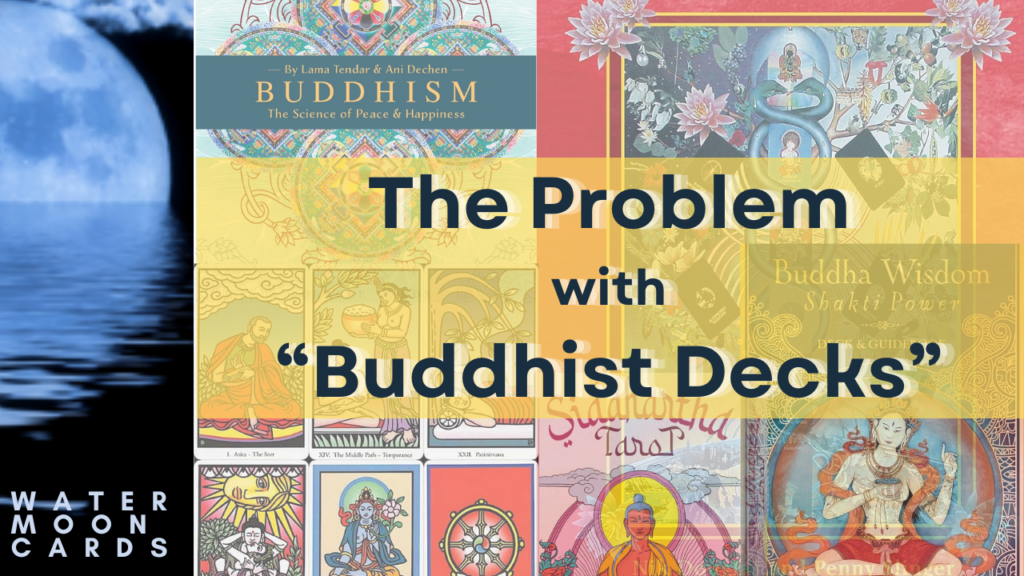
The Buddha Tarot: A Mandala of Cards, by Robert M. Place, Red Feather, 2022
Buddha Wisdom, Shakti Power by Laura Santi, U.S. Games Systems, 2018
Siddhartha Tarot, Bruno Letizia, Lo Scarabeo, 2022
Tantric Dakini Oracle, by Penny Slinger and Nik Douglas, publisher, 2003
Publication I’m not sure about:
Buddhism Oracle Cards: The Science of Peace & Happiness, by Lama Tendar and Ani Dechen, U.S. Games Systems, 2024
Publications I suggest instead:
If you want to learn a little about Buddhism in general, I can recommend any book (not cards) written for a general audience by Thích Nhất Hạnh, His Holiness Tenzin Gyatso (the 14th Dalai Lama), Ani Pema Chödrön, Dzigar Kongtrul Rinpoche, or Jetsun Khandro Rinpoche. To proceed beyond this basic level of curiosity you will need to find a teacher to study with. Most sanghas offer some level of public programming and newsletters so you can get a feel for the teacher, student community, and particular practice and study path they offer.
In the video I mention these specific resources:
Lojong (mind training) cards and commentaries. These are available in a range of translations from various schools of Buddhism, including:
The Compassion Book: Teachings for Awakening the Heart, by Ani Pema Chödrön, 2017
Enlightened Courage: An Explanation of the Seven-Point Mind Training, by H.H. Dilgo Khyentse Rinpoche, Snow Lion, 2006
The Great Path of Awakening: The Classic Guide to Lojong, by Jamgon Kongtrül Rinpoche, Unfettered Mind, 2018
The Intelligent Heart: A Guide to the Compassionate Life, Dzigar Kongtrül Rinpoche, Shambhala, 2016
These decks of cards feature phrases and quotes pulled directly from commonly-used texts to illustrate fundamental concepts such as the Four Noble Truths, the Eightfold Path, the Six Perfections, the Four Immeasurables, and so on:
Buddhism Reading Cards: Wisdom for Peace, Love and Happiness, by Sofan Chan, U.S. Games Systems, 2017
Tibetan Buddhist Meditation Deck: Insights, Visualizations, and Exercises to Help You Find Harmony and Inner Peace, by Gill Farrer-Halls [uncredited], Watkins, 2011
Only for practitioners of Tibetan Buddhism who are looking for a compact collection of images to use with authorized practices:
Tibetan Buddhism Deck, Priya Hemenway, Chronicle Books, 2003 (OOP)
Finally, the tarot deck that I use to read about my spiritual practice (more on this in a subsequent video):
Margarete Petersen Tarot: 78 Tarot Cards with Detailed Instructions, Königsfurt-Urania, 2021