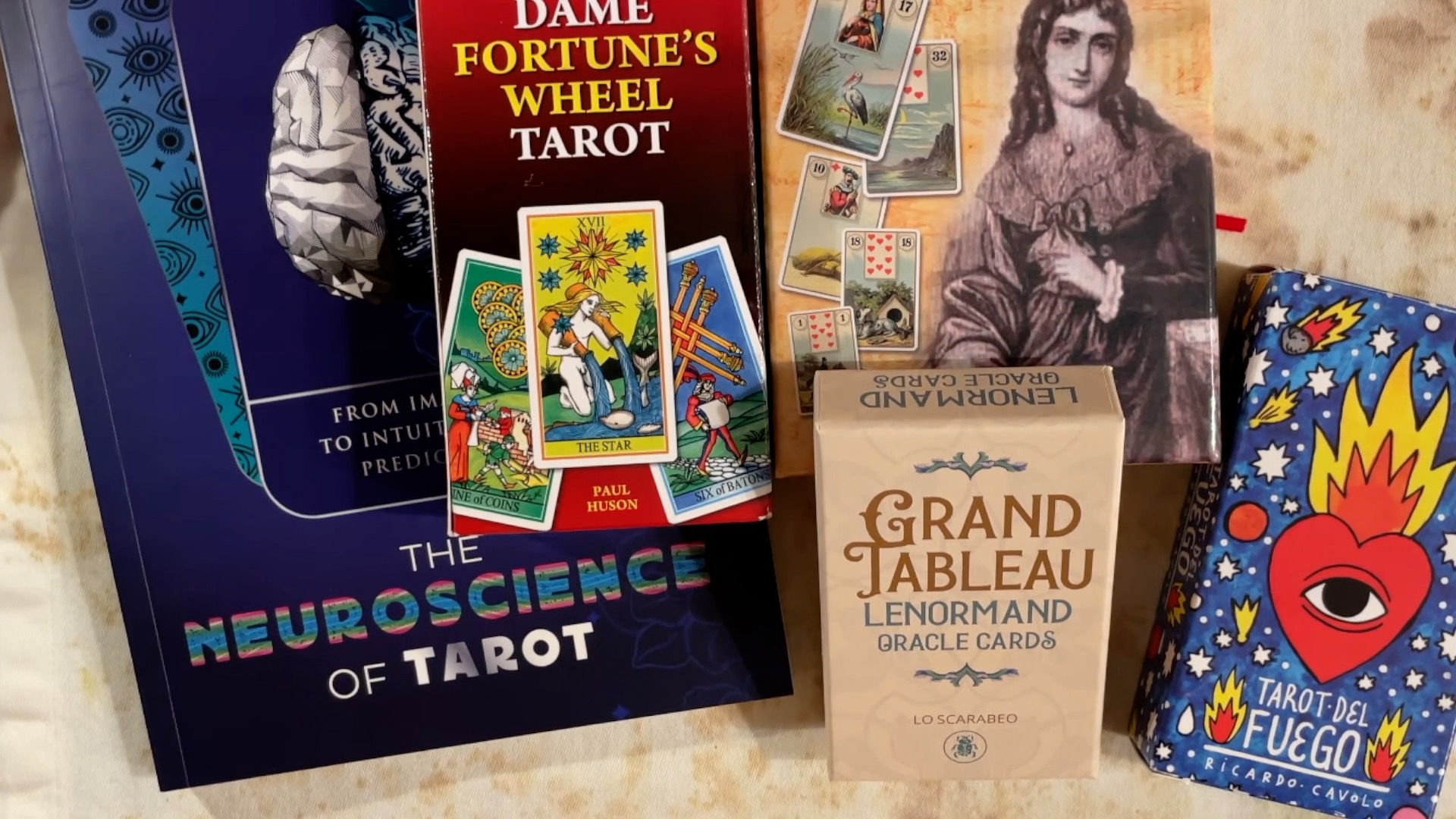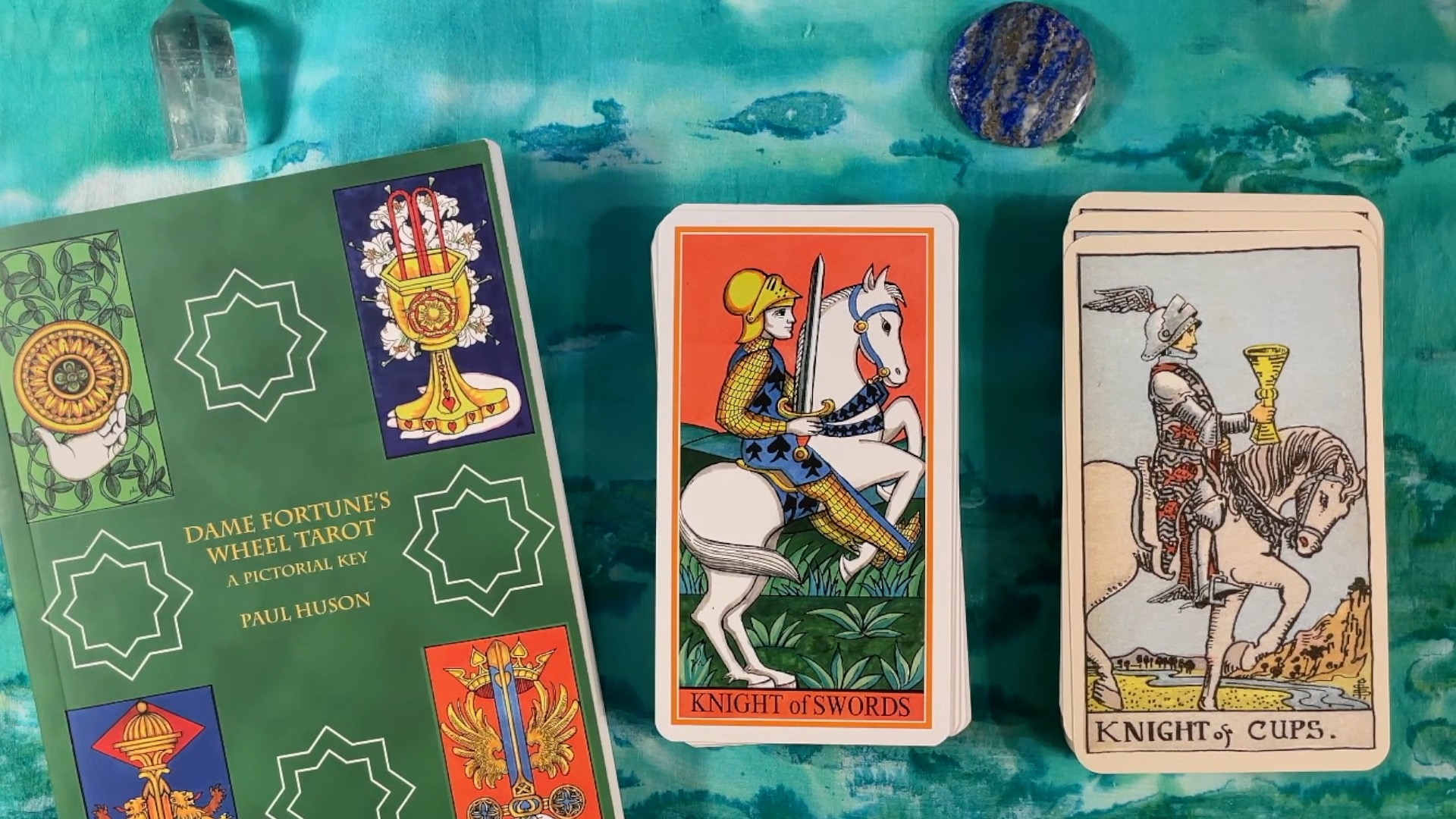
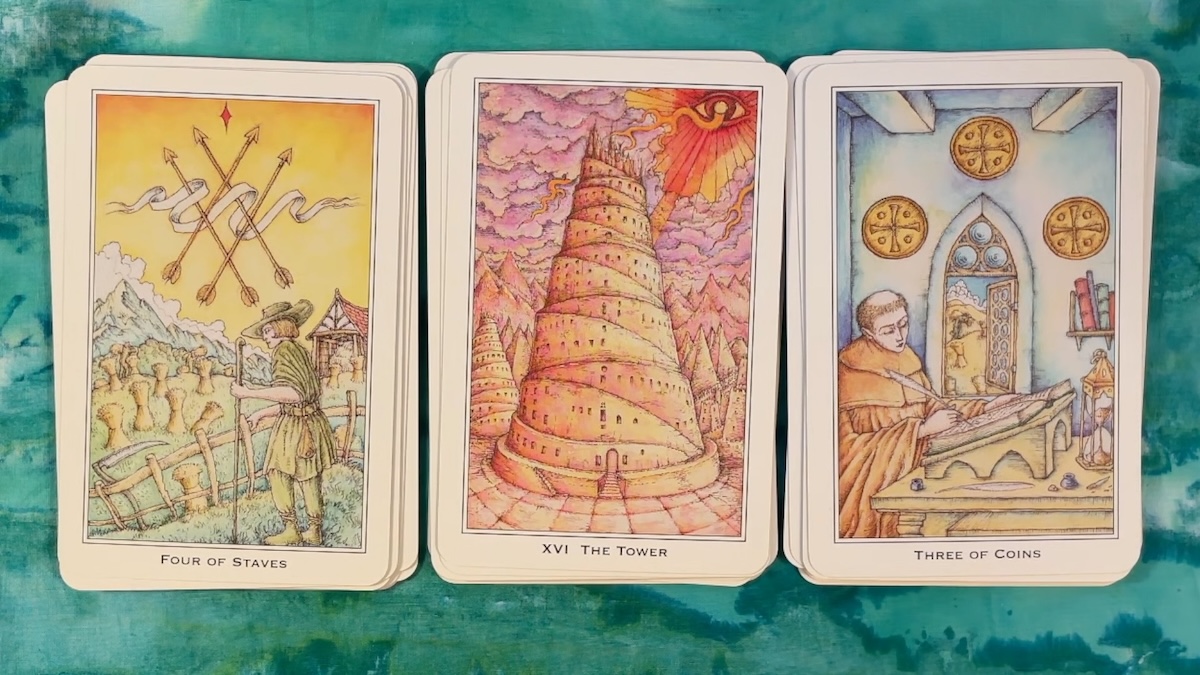

After completing the DROPM78 tarot challenge earlier this year with the Dame Fortune’s Wheel Tarot, I didn’t think I’d want to do it again so soon, if at all. Journaling, comparing notes with my study buddies and making daily videos was a ton of work, and while I learned a lot, one of my primary takeaways was that I really couldn’t read with that deck; a disappointing outcome.
I’m glad I realized that now, though, rather than letting it hang out on my shelf unused for an even longer period. (If you’re not familiar with the DROPM78 study challenge, you can learn about it from the inventor, Esther of Mindful Tarot.)
What changed?
Well, inspiration hit, in the form of seeing Ina of Taproute Tarot’s video comparing two of Nigel Jackson’s decks (he’s published a number of them). I had remembered seeing images of his nominative deck years ago, being vaguely curious about it, but not really “getting” it, and it’s been out of print for ages, so it wasn’t worth tracking down at the time. I also recalled seriously considering the Rose Tarot when I was first learning to read Marseilles and other pip-style decks, but that one is too Hermetic / Rosicrucian / Christian Mysticism in its orientation and imagery for me to appreciate.
The Nigel Jackson Tarot, (aka Medieval Enchantment – more on this below) has some aspects in common with Dame Fortune’s Wheel Tarot; aspects that I enjoyed when I studied that deck: medieval imagery, more neutral images than Pamela Coleman Smith’s interpretations, and a certain hewing to Etteilla’s card interpretations, in some cases, vs. the Golden Dawn titles. But the main selling point was numerology. When Ina mentioned the use of Pythagorean numerological associations for the numbered cards, that pushed this deck further up my wishlist, and seeing the art again with fresh eyes, and with more years of tarot reading experience, sealed the deal.
Of course, it’s still out of print, so I had to hunt for a set that was complete, in good condition, and not a stupid price. (Currently on eBay there are two decks listed for $450 or more: greed in the tarot collecting world at its most apparent. Who wants this very odd, very niche deck? Not very many people, but yet you think you can get a massive amount for it just because it’s out of print. /rant)
Publication Tomfoolery
In searching for and eventually purchasing this deck, I discovered there were two versions of it published, sort of:

Publication #1, The Nigel Jackson Tarot, Llewellyn, comes in a white slipcase that is just large enough to hold the booklet and the separately-boxed deck of cards. The booklet also has a copyright date of 2000 on the title page.
Publication #2, Medieval Enchantment, The Nigel Jackson Tarot, Llewellyn, is packaged in a much larger outer blue box, decorated with stars and an image of the Ace of Cups card which holds: an identical boxed deck of cards, identical booklet with the 2000 publication date, an empty filler cardboard box designed to keep the other contents from shifting around, and a black organza tarot bag (useless!). The outer box is marked ©2004.
I strongly suspect that Llewellyn was having trouble selling The Nigel Jackson Tarot because he is not and as far as I know has never been a household name (unlike A.E. Waite, Crowley, Rachel Pollack, Barbara Moore, Mary Greer, etc), and so potential buyers were not interested in investigating this publication. (Who the heck is Nigel Jackson, and why should I care?). I assume that in an effort to shift their languishing back-stock of this print run, the publisher repackaged the deck and booklet in their standard-sized box of the time, and gave it a romantic name and pretty design that would look enticing on a shelf in a metaphysical store.
Ina graciously confirmed that our booklets are identical, so I feel confident in my guess as to what happened here. This is all to say if you are looking for this deck, either version will do (though the marketing seems to be effective, as the Medieval Enchantment rebranded version typically is listed for higher prices than the original).
Perusing the guidebook
After receiving my used copy, it all came down to the booklet: would it deliver? At first review, it does. I have not read the card meanings in-depth, but I have skimmed those a bit, and read through the sections on “tarot history,” Jackson’s instructions for conducting readings, and his overview of Pythagorean associations and sample spreads.
What is tricky about the booklet, and typical of esoteric writers, is that Jackson blends verifiable historic fact with faux-gravitas quackery. (Always check your sources and your sources’ sources, kids!) But I like what he says about conducting readings, and the ways that he applies his understanding of Pythagorean associations is interesting in a big-picture way. We’ll see how it plays out card-by-card, but I have hopes that this deck, unlike Huson’s, will have some internal structure and consistency across the minor suits (all 2’s have certain characteristics, as do all 5’s , Pages, etc).
In the guidebook, Jackson gives both “magical” and “divinatory” meaning for the majors, while the courts and numbered cards get divinatory treatment only. Jackson also gives a number of spreads that I have not seen elsewhere, including a 10-position spread he calls The Pythagorean Method, which links each position to its corresponding major card, from Magician to Wheel of Fortune. This reminds me of the Lenormand Grand Tableau, and I’ll be interested to try it out.
In the last chapter of the guidebook, Chapter 3: Stations of the Psyche, Jackson offers a method of meditation with each of the major arcana cards. This is something that is often referenced in the writings of Waite, Crowley, and other ceremonial magicians / tarotists, but I have never seen the method explained step-by-step before. Interestingly it aligns with some aspects of a particular meditation I have learned from studying Buddhism. However, I would advise caution in trying to practice this style of meditation on one’s own, with out a spiritual advisor or meditation instructor of some kind, who can help you if you get confused or overwhelmed by the process. (I have not and will not be practicing this myself.)
Setting a course of study
The DROPM78 card-by-card study period runs from October 15 through December 31. I’m excited to be jumping back in, this time with a greater number of peers, including Ina from Taproute Tarot, Tarot and Things with Mims, Jay from Iridescent Tarot, Ellen from Moom In Tarot, Night Owl Nina Tarot, and, surprisingly, my mother, who told me just yesterday that she’d had her eye on this deck for years but wasn’t quite motivated to get a copy until I mentioned it to her. If you are participating please tag yourself in the comments!
This learning challenge incorporates an optional comparative aspect, and I decided I wanted to compare Jackson’s approach to numerology with another author I’ve been meaning to read, Anna Maria Morsucci. I’ll be using these resources (both of which I also learned about from Ina – she’s such a powerful influence!):
Marseille Vintage Tarot (deck and booklet), based on the original work of Nicholas Conver, Paris, ca. 1760, Lo Scarabeo, 2022. The booklet that comes with the deck is written by Anna Maria Morsucci; images are by Mattia Ottolini and Chiara Demagistris with input by Morsucci.
I was interested in this deck for several reasons, including the addition of a question for each card entry, related to that card. I love a guidebook that includes not just definitions or interpretations, but prompts for our own investigation. Unfortunately, LoScarabeo has let this go out of print, but I was able to pick up a gently used copy for $12.
Tarot of Marseille Guide to Interpretation, Lo Scarabeo, 2023, written by Anna Maria Morsucci, images researched by Morsucci and restored by Antonella Aloi.
This is a revised and slightly expanded edition of Morsucci’s Reading and Understanding the Marseille Tarot, Lo Scarabeo, 2019. I may not read this cover-to-cover during the challenge, but I’m glad to have this in my library now, as an alternative to Yoav Ben-Dov, who is just too esoteric and convoluted for my taste. I plan to use this book as a support during the end of this year and then give it a more focused read through in 2027.
So, tell me in the comments: are you doing a DROPM78 challenge this year, or have you done one in the past? What deck did you study, and what did you learn? Are you comparing with other sources? What are your goals for a card-by-card look at the tarot?