First, let me wish you a happy Pride Month, and a wish that you are able to live your life and express yourself, in all your complexities, however you feel comfortable, and feel safe and supported in doing that. I recognize not everyone is in that position right now, either for personal reasons or increasingly, cultural ones. I hope you have people in your life who see you and value you for who you are.
This post is inspired by specific videos from 4 people, exploring the topic of queer representation in tarot:
1. Tom Benjamin in his original Queer Decks for Pride and Any Time video asks where we are seeing ourselves and our friends represented.
2. Avory Faucette expands on this, asking us to consider what we think queer is, and how we can know what it is. They offer different categories to think about with their deck choices. And, Avory has the same caveat that I do: this is my own feeling and my feeling today. How I interpret or respond to this artwork will be different for other people who have different experiences and culture. Not all of these artists would say their deck is queer, nor would everyone universally interpret the people represented in the same way; I might not even do that depending on the reading. Like everything else, queerness has a contextual aspect to it.
3. Laura of Aquamarine 18 has posted a couple of responses and later received some uncomfortable questions about “non-obvious” decks from folks who were possibly looking for a way to figure out what they could add to their collections to be more “inclusive” without having something that they don’t resonate with, that makes them uncomfortable, or that they don’t understand. I understand Laura’s discomfort and agree with her video essay response to this question, because it can be interpreted as: “Can you help the straight, CIS-gendered person be more comfortable in or near 2SLGBTQ+ spaces or people?” The answer in a time when violence against and active suppression of community members is increasing is: no. It’s not our job to make ourselves more palatable.
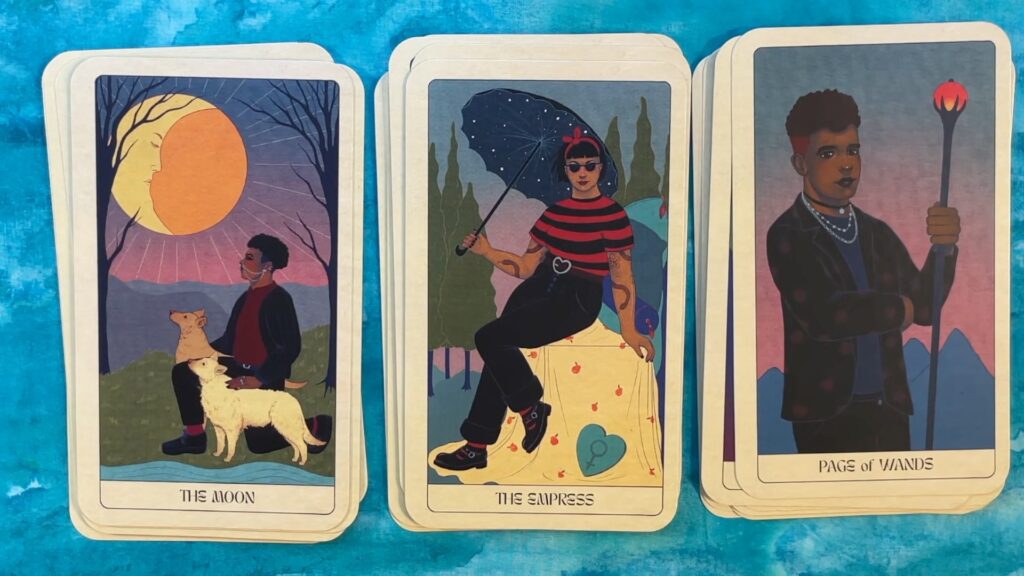
At the same time, this question about “non-obvious representation” resonated with me because I am a “non-obvious” queer person. I tend to keep personal information more private. I have a lot of different styles of clothes I like to wear, some more femme, some more gender-neutral or gender fluid, but all of them are low-maintenance and comfortable. I don’t tend to wear makeup or use a lot of accessories. And I’m not alone; in my local community people aren’t dressing for the club / the dungeon / the drag show, like we see in the Gay Marseille, New Voice or New Choice tarots, for example. My daily contexts to interact with others are: work / school, coffee shop, grocery store, and community events.
Even at the local bar run by a gay couple, unless it’s a special dance party night with a DJ, or a pride event, people aren’t being that overt in the way they present themselves. So, in general, decks that show people with heavy costuming, makeup, or lots of nudity don’t accurately represent my lived experience. Dressing up (in any way) is not part of the culture in rural New England – it’s cold and a lot of people do manual labor. People don’t have a lot of extra money for special occasion outfits, and tend to wear warm, practical clothing, whether they’re at work or having drinks with friends.
In terms of nudity as a form of expression, I don’t have queer or straight decks with a lot of naked people in them – I just don’t tend to relate to the oracle that way. Reading on spiritual matters and human relationships in all their complexity, not just sexual intimacy, means that nudity is often out of place. For most situations or questions, whether for myself or for others, people tend to have their clothes on. Even for the Valentines readings I gave a couple of months ago, when people were asking me about their relationships, they were asking about the interaction with their partner on a mental or emotional level. Maybe people around here just don’t want to talk about sex with a stranger, but the topic almost never comes up, so I don’t find nudity to be relevant most of the time. It’s fine if it’s there, but it’s not something I gravitate towards.
Let me reiterate that “obvious” decks – ones that show a very specific queer aesthetic, such as neon color palettes, certain articles of clothing, rainbows, triangles, and other symbols, or that make character’s trans-ness or sexuality explicit by showing naked bodies or sexual activity – are very important to have access to. Representation of all aspects of queer life and the entire spectrum of identity is important, and I want to make it clear that just because I personally gravitate to some art and not other art, it does not mean that I think one is better, or more valid, or more accurately representative of our big and very diverse community. It just happens to better represent my lived experience and the way my friends and community around me choose to express themselves.
4. Emmay the Gray posted a very touching video about decks that resonated with her personally, where she felt represented and saw her friends and loved ones represented for a variety of reasons: the deck’s overall aesthetic, the specific images, the artist’s identity, or just a vibe. And she asks an interesting question: Isn’t art created by a member of the community inherently queer / trans, even if that is not intentionally encoded into the imagery?
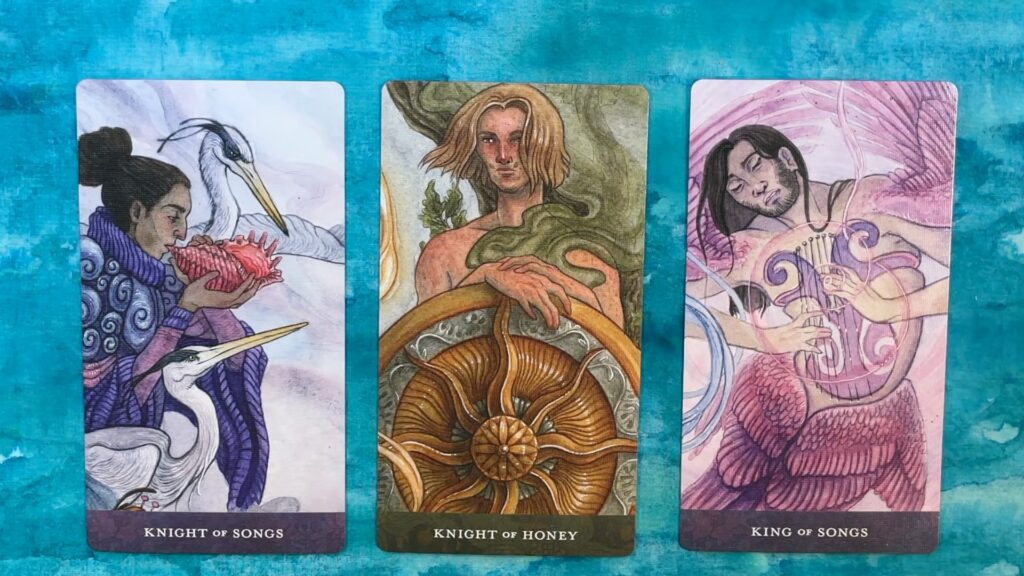
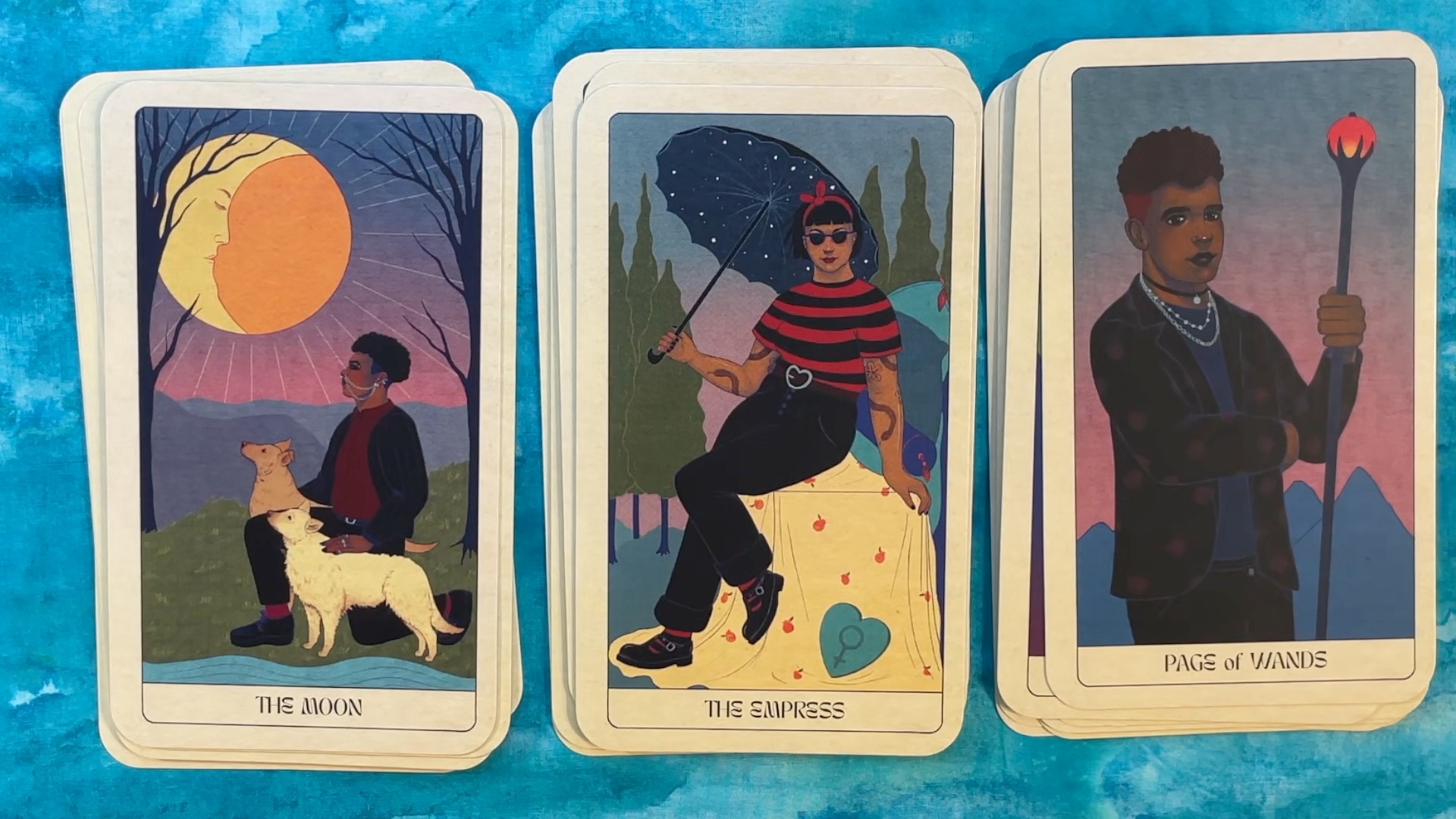
Considering all of this, instead of “obvious” vs. “not-obvious” I’d like to use “explicit” vs. “implicit” to signify low-effort modes of self-expression vs. more boisterous or involved expressions of gender identity and sexuality. If you are a member of the community or you have good ‘dar, even implicit signals will be very obvious, at least at a general level – you won’t know specifics unless you get to know the person. What I can tell you about any of the people pictured in these examples is that they appear queer to me, at least some of the time.
And that qualifier, “some of the time” is also important to me: implicit representation allows us as readers to have more room for situational or contextual interpretation, depending on the person doing the reading, the one receiving the reading, the question or topic, and other cards. Explicit representation of sexuality and gender identity is important to have access to, and it can also be more defining in a reading. The same is true for any explicit representation of body attributes or personal identity.
As an adjunct to this discussion, I want to share some decks that are from or represent community, but that are not (with one exception) marketed as such: nothing in the title, or the guidebook (if there is one) states that these are gay / queer / trans decks, yet that is what they represent to me.
My Collection
Blood Moon Tarot, Sam Guay, 1st ed. self-published, 2nd ed. (shown), U.S. Games Systems
Cosmic Tarot, Norbert Lösche, AGM Urania
Estrella Tarot, Ash La Estrella, self-published
Fifth Spirit Tarot, Charlie Claire Burgess, 1st ed. self-published (shown), 2nd ed. Hay House.
The Modern Goth Tarot, Natalie Foss, Skittledog Press
Tarot Del Fuego, Ricardo Cavolo, Fournier
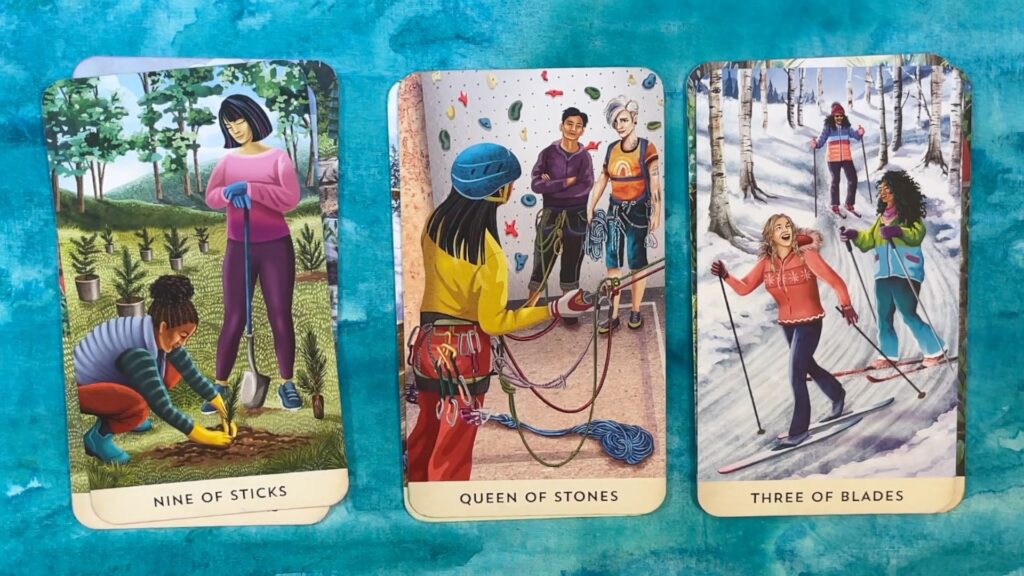
Tarot of the Great Outdoors, Julie Gordon; Mountaineers Books
Tarot Siréne, Jorge Cuaik aka Wandering Oracle, self-published
Yarn Tarot, Katie Ponder, Sixth & Spring Books
There are dozens, probably hundreds of other queer decks that have been published over the past 50 years. If you’re looking for recommendations, watch videos and reviews from the folks listed above, or search YouTube for Queer Decks for Pride to see additional responses. I think it’s wonderful we have much more abundant choice in representation now and hope to see that continue in tarot publishing.